MUDRA loan eligibility begins with your business and borrowing history, not the largest amount in an advertisement. A shop owner who needs money for inventory faces a different decision from an established manufacturer buying a machine. Before applying, identify the purpose, calculate the amount you can repay and choose the appropriate loan category. This guide helps first-time borrowers prepare that decision without assuming that a government-backed scheme means automatic approval.
Consider a small cosmetics retailer in Assam. The retailer wants additional stock before a festival, but also needs cash for freight, rent and ordinary household withdrawals. Asking for the maximum possible loan may create an instalment that the business cannot support after the festival. A better application connects a specific purchase plan with realistic collections and an affordable repayment schedule.
- Define the business expense.
- Check the applicable MUDRA category.
- Prepare records and a cash-flow estimate.
- Compare the lender’s written terms.
- Borrow only after testing repayment capacity.
A scheme limit is a ceiling. Your suitable borrowing amount may be much lower.
What MUDRA does, and what it does not promise
The Department of Financial Services describes PMMY as credit for eligible small business activities through participating lending institutions. Its categories include Shishu up to ₹50,000, Kishore above ₹50,000 and up to ₹5 lakh, Tarun above ₹5 lakh and up to ₹10 lakh, and Tarun Plus above ₹10 lakh and up to ₹20 lakh. The official scheme information is the starting point; the lender still assesses the application.
Tarun Plus has an important condition: it is intended for entrepreneurs who previously borrowed under Tarun and successfully repaid that loan. A person applying for a first MUDRA loan should therefore not treat ₹20 lakh as an automatic entitlement. Ask the lender which category fits your record before paying for a project report or committing to a supplier. These category details are drawn from the official PMMY information linked below.
Start with a purchase plan, not a round number
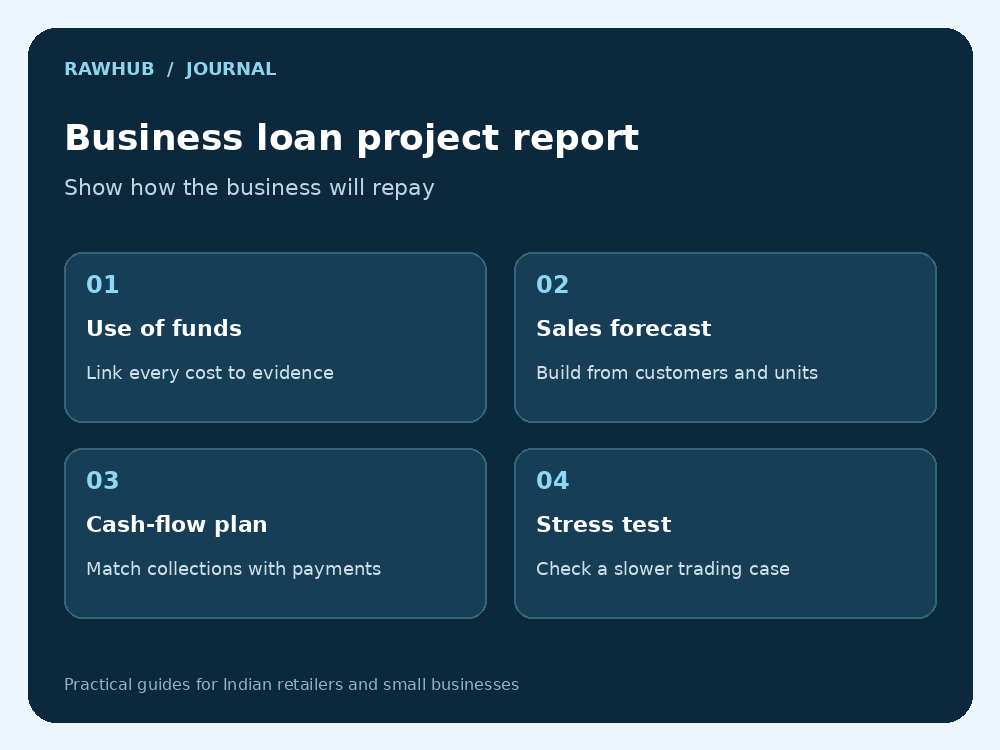
List what the money will buy. Separate opening stock, equipment, freight, packaging and operating expenses. If the request is mainly for inventory, attach product quantities and supplier quotations. If it is for a machine, explain installation, electricity, operator training and expected output. A lender should be able to understand the connection between the expense and the business’s ability to earn and collect money.
Remove costs that you can comfortably fund yourself, but keep enough cash for essential operations. Borrowing ₹3 lakh for stock while leaving nothing for delivery or rent is not a complete funding plan. Conversely, adding an unexplained buffer can make the proposal look weak. Name each reserve and explain the risk it covers. Use a separate contingency line instead of hiding extra cash inside inflated supplier quotations.
Prepare a consistent document folder
Request the lender’s current checklist because requirements depend on the applicant and facility. Common preparation includes identity and address records, business constitution documents, bank statements, existing loan details, business registrations where applicable and evidence of the intended purchase. An established business should organise sales records and financial statements. A new enterprise should clearly distinguish projections from actual trading history.
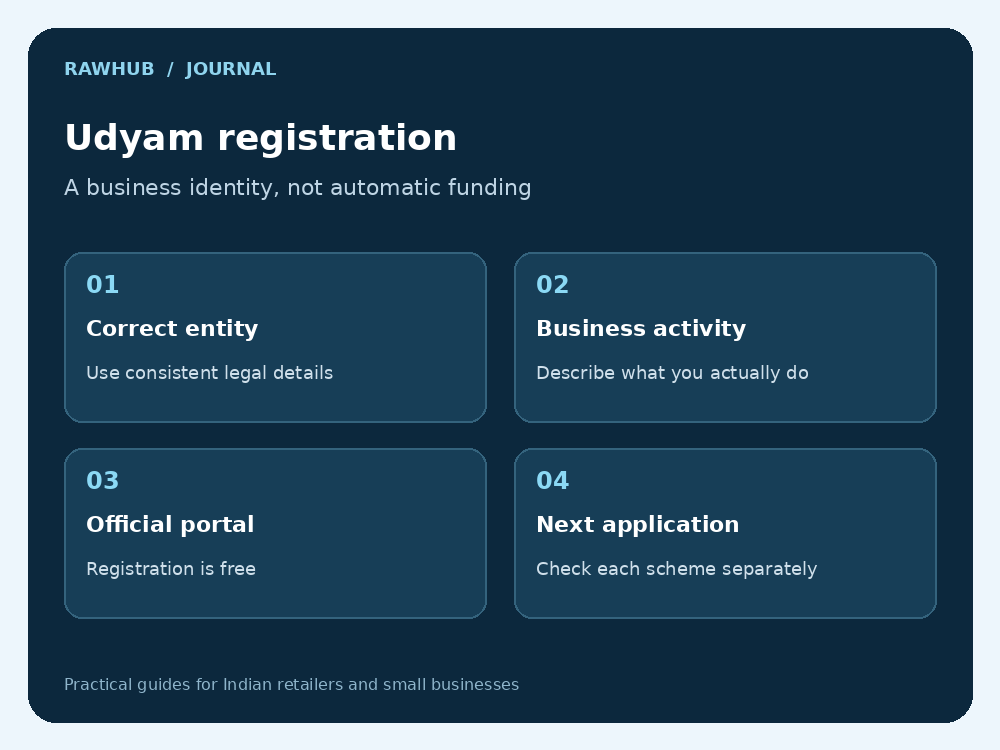
Check consistency before submission. The legal name, address and business activity should agree across the application, bank account and supporting records. For a partnership or LLP, confirm who is authorised to apply and sign. Do not upload a partner’s personal account statement as though it were the company’s turnover record. Where a genuine difference exists, add a short explanation and the appropriate supporting document.
Build a simple monthly repayment test
Estimate cash collected from customers, rather than total bills raised. Deduct the cost of replenishing goods, rent, wages, utilities, transport and taxes that must actually be paid. Then deduct existing loan instalments and planned owner withdrawals. The remaining amount is the starting point for assessing a new repayment. It is not all automatically available: the business also needs protection against slow sales and unexpected expenses.
For illustration, suppose monthly collections are ₹2,40,000 and stock purchases plus operating cash expenses total ₹2,05,000. This leaves ₹35,000 before existing debt, withdrawals and reserves. If those items need ₹20,000, only ₹15,000 remains. A proposed ₹18,000 instalment would already exceed that simplified balance. These are teaching figures, not a lender’s formula or an estimate of what your shop will earn.
Compare the complete cost of borrowing
Do not compare offers using the interest rate alone. Ask about processing charges, mandatory third-party costs, repayment frequency, security requirements, late-payment charges and prepayment terms. Confirm whether the rate is fixed or floating and how a rate change affects the instalment or tenure. Read the sanction letter and loan agreement together so a verbal promise does not become your only record of an important condition.
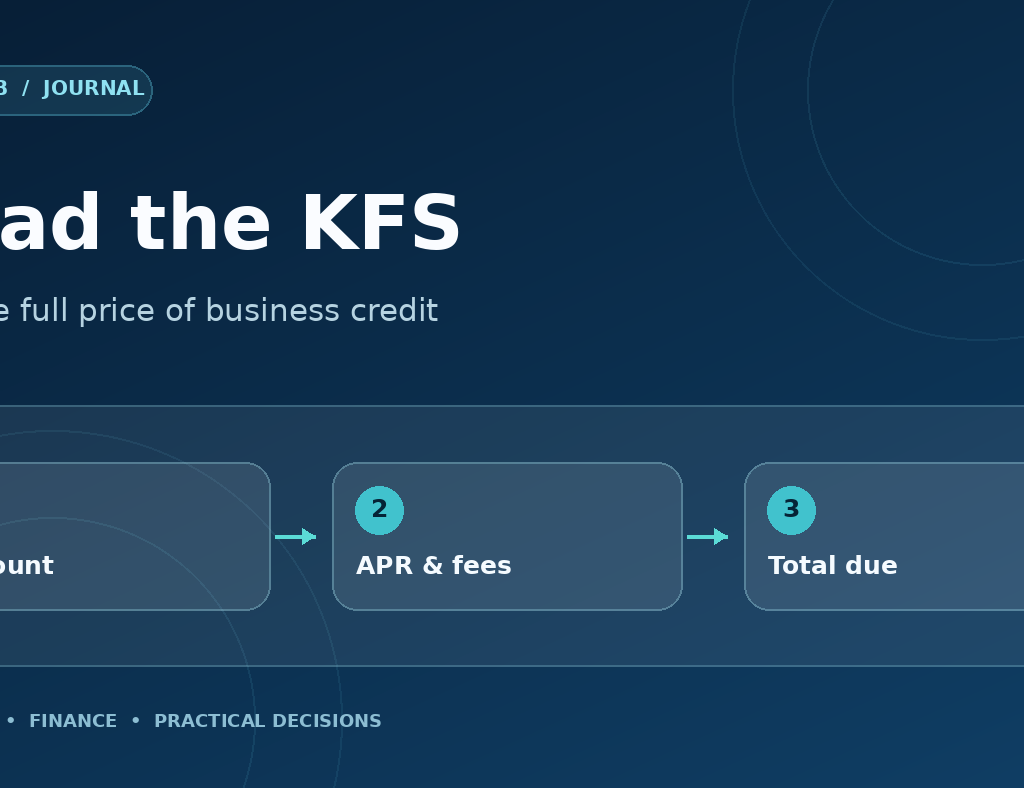
Where a Key Facts Statement applies, use it to compare the annual percentage rate and repayment schedule. Rawhub’s guide to reading a loan Key Facts Statement explains the questions to ask. Keep the comparison on the same amount and tenure. A smaller monthly instalment can result from a longer repayment period and may increase the total interest paid.
Match the facility to the business cycle
Inventory borrowing should be assessed against the time needed to receive goods, sell them and collect payment. A shop that buys seasonal garments may face a sharp sales window followed by markdowns. A distributor selling on credit might earn a margin but wait several weeks for cash. Write these dates into the plan. Profit on paper does not pay an instalment before the customer’s money arrives.
Equipment has a different pattern. It may take time to install and start generating useful output. Ask how repayments begin relative to commissioning, but do not assume a grace period will be available. Compare the proposed purchase with renting or using an existing machine more efficiently. Borrowing is worthwhile only when the business case remains sensible after interest, maintenance and the risk of lower-than-planned demand.
A stronger application explains the weak month
Prepare three versions of the forecast: expected trading, slower sales and delayed collections. The point is not to produce impressive spreadsheets. It is to identify when the account could run short. In the slower case, reduce sales while keeping expenses that will not fall immediately. In the delayed-collection case, move customer receipts into a later month without moving the supplier’s payment deadline.
Then decide what you would do. Possible responses include buying a smaller opening assortment, negotiating staged supply or delaying non-essential equipment. Avoid relying on another unapproved loan to make repayments. A credible plan acknowledges uncertainty and shows how the business can respond. A proposal that assumes every item sells immediately at the full retail price gives very little room for ordinary trading problems.
Use sourcing records to support the proposal
Clear purchase records help explain how funds will be used. Keep the supplier’s identity, quotation date, product specification, quantity, payment terms and delivery conditions together. Compare landed cost rather than the cheapest unit price. For wholesale buying, read Rawhub’s landed-cost checklist and review the live marketplace for currently available products and terms.
A marketplace listing is not a loan sanction, a guaranteed margin or proof of future customer demand. Use it as one sourcing input. Test demand with actual customers and avoid buying an oversized assortment simply to use the full loan amount. Preserve invoices after purchase and reconcile payments against the business bank account. This makes subsequent performance easier to review and future financing discussions more concrete.
A practical application sequence
- Write a one-page summary of the business, funding purpose and amount.
- Ask the chosen lending institution about eligibility and its current document checklist.
- Prepare quotations, records and a monthly cash-flow forecast.
- Submit accurate information through the lender’s verified channel and retain the acknowledgement.
- Respond to clarification requests with consistent supporting evidence.
- Review the final written offer before accepting any disbursement.
Track the application reference, submission date and outstanding documents. If the lender declines, ask which factors can be improved and whether a smaller or different facility may fit. Do not repeatedly submit conflicting figures to several institutions. Correct the underlying issue, such as incomplete records or an unrealistic purchase plan, before treating a new application as the solution.
Frequently asked questions
Can a first-time borrower get ₹20 lakh under MUDRA?
Do not assume so. Tarun Plus has a prior successful Tarun repayment condition. A first-time applicant should discuss the applicable category or a different business-loan product with the lender.
Does a MUDRA loan mean free government money?
No. It is borrowing that must be repaid under the agreed terms. Do not confuse a loan category with a grant, subsidy or waiver.
Can an agent guarantee approval?
An agent’s promise is not the lender’s decision. Verify the institution, request written terms and avoid sharing account passwords or paying unofficial approval charges.
What should I do before applying?
Calculate the expense, collect quotations, organise business records and test repayments in a weak sales month. A smaller affordable request is often more useful than a larger amount that creates immediate pressure.
Sources and editorial note
Official reference: Department of Financial Services — Pradhan Mantri MUDRA Yojana. Information checked on 9 October 2026. Illustrations and planning examples are editorial, not promises of approval or returns. Confirm current eligibility and terms with the lender. Rawhub provides wholesale marketplace information; this article is general education and does not constitute a lending offer.