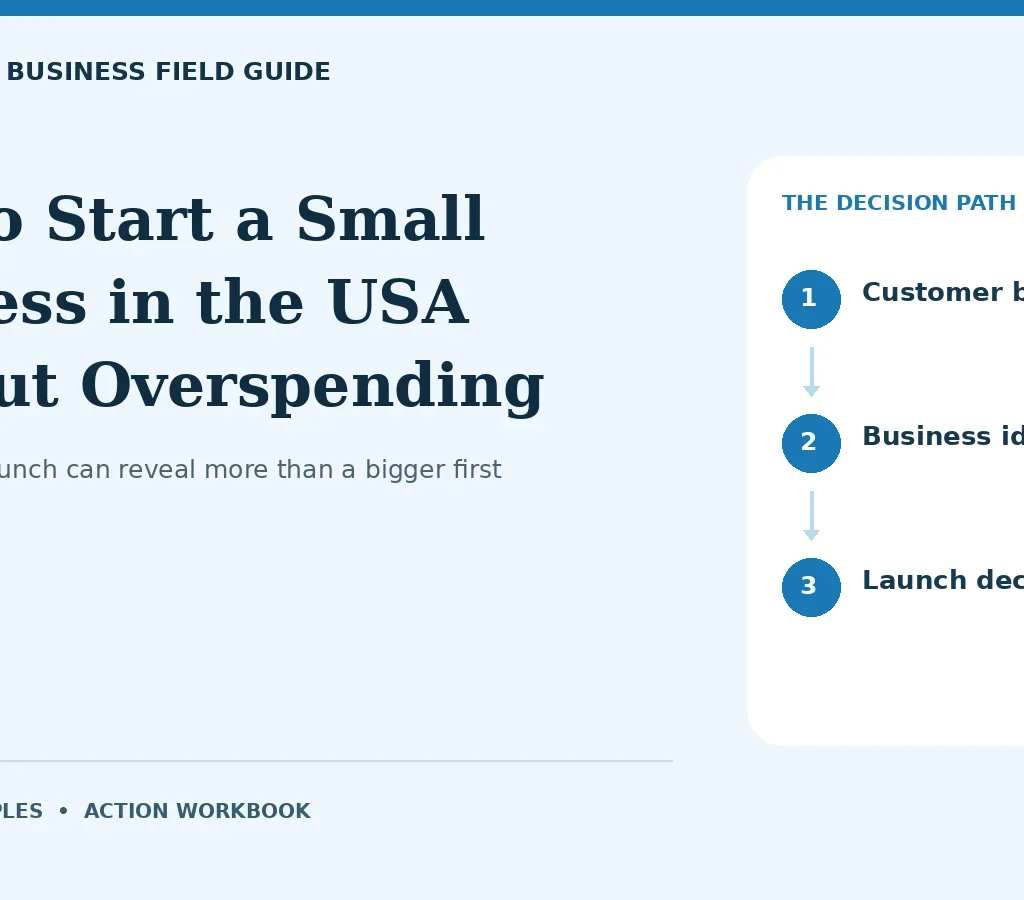
A smaller first launch can reveal more than a bigger first investment.
A beautiful logo is not evidence that a business will work. Neither is a long list of things you could sell. Your first useful question is narrower: who has a problem expensive enough that they will pay you to solve it? For an American small-business owner, that question connects directly to rent, insurance, payroll, permits, and cash in the bank. This guide helps you sequence those decisions so that spending follows evidence. You do not need to finish every possible administrative task before testing demand, but you must understand which legal requirements apply before accepting work or making sales.
Choose one customer and one job
A home-cleaning company could serve everyone in a city, but that description makes marketing difficult. A tighter starting point might be recurring cleaning for busy households within a defined service radius. Write the customer, the trigger that makes them buy, and the result you promise. Avoid selecting a niche only because someone calls it profitable. Ask potential buyers what they currently do, what frustrates them, and what would justify changing providers. Listen for specific circumstances rather than compliments. A customer describing their last purchase gives stronger evidence than a friend saying your idea sounds exciting.
Test a real offer before building infrastructure
Design a small paid pilot with a clear price, scope, and completion date. A service business might offer a limited number of appointments; a product business might test a small batch without implying that unavailable stock is ready to ship. Explain the limitations honestly. Track inquiries, qualified conversations, purchases, refunds, and delivery time. The pilot is useful even when it disappoints you: it can reveal that customers want a different package, a faster turnaround, or a lower-risk first purchase. Do not treat unpaid interest as equivalent to money collected.
Separate setup costs from survival costs
A launch budget should distinguish one-time expenses from recurring bills and transaction-level costs. Equipment and initial branding belong in a different conversation from monthly rent and insurance. Packaging, payment fees, and delivery may increase with every order. Also plan for the cash gap between paying suppliers and collecting from customers. Include owner living expenses in a separate personal plan rather than hiding them inside a business profit estimate. The purpose is to discover the smallest viable launch, not to produce an impressive total that a lender will automatically approve.
Make location-specific administration a workstream
Business structure, registrations, licenses, zoning, and tax obligations depend on your activity and location. Federal guidance is a starting point, not a complete state or city checklist. The SBA directs founders to local resources when launching, and the IRS provides a starting-business tax hub. Use those official pages to build your own questions. A food business, an online consultant, and a construction contractor will not have identical requirements. Assign each unanswered question an owner and a deadline before the associated activity begins. Keep confirmation documents where you can retrieve them. Official reference: SBA: Launch your business, IRS: Starting a business.
Build operations around the first ten customers
Your first operating system can be simple: an inquiry log, written quotes, a payment process, a delivery checklist, and a customer-support channel. Decide how cancellations, scope changes, and refunds will be handled before disagreements happen. Keep business transactions traceable. A basic website should tell customers what you do, where you serve, what happens after they contact you, and how to verify your identity. Add sophistication only when the simple version causes a measurable problem. Early automation is valuable when it removes a repeated task rather than merely making the business look larger.
Use a launch gate instead of a launch date
A calendar date can motivate you, but it should not overrule obvious gaps. Set a launch gate: a tested offer, known delivery costs, completed applicable administration, a way to collect and record payments, and enough capacity to fulfill the first orders. Decide what would make you pause. If every sale loses money or the service cannot be delivered safely, more promotion will intensify the problem. Keep the first public promise achievable. Customers tend to remember whether the business delivered what it promised more than how elaborate the announcement looked.
A worked example
Illustrative example: Maya tests a mobile organizing service instead of leasing an office. She budgets $650 for initial supplies and basic setup, then keeps $1,850 available for operating needs. Four pilot appointments at $180 generate $720. Each uses $35 of supplies and travel plus three hours of her time. Before treating the remaining cash as profit, she accounts for her labor, insurance, administrative work, and any applicable taxes. Her useful discovery is that appointments outside a tight radius consume too much travel time. She narrows the service area before buying advertising. These are hypothetical figures, not an estimate of typical US startup costs.
Try your own numbers
Change the example inputs to explore this simple planning relationship.
Initial launch cash ($)Illustrative arithmetic only. This tool does not estimate taxes, loan eligibility, legal requirements, insurance coverage, or net profit. It uses no external service and does not store your inputs.
The worked example and formula above remain available without JavaScript.
Your action workbook
Use the following checkpoints as a working document, not a score that promises success. Each one connects a specific action to evidence and a warning sign. Review the items in sequence or start with the weakest area in your business. The checkboxes are a temporary reading aid; they do not save personal information or certify compliance. Keep any actual records securely in your own operating system. For questions involving legal, tax, lending, insurance, or employment obligations, obtain appropriate current guidance. Your final decision should reflect the evidence, the cost of being wrong, and the capacity to maintain the process after the initial setup.
01 Customer boundary
Establish the starting point. Write the household or company you serve and the situation that triggers a purchase. Keep this in a dated decision record. Assign any unresolved question to a responsible person before committing money or making a customer promise.
Evidence to keep: Five recent customer conversations describing an actual purchase.
Warning sign: A target market described as everyone in America.
02 Pilot offer
Test before committing. Sell one tightly scoped service or small product batch with a realistic delivery promise. Use a representative situation, record the result, and revise weak assumptions before expansion. A small test should inform the next decision, including when to pause.
Evidence to keep: Paid orders with recorded delivery time and feedback.
Warning sign: Counting likes and survey enthusiasm as sales.
03 Startup budget
Make the evidence retrievable. List equipment, setup fees, deposits, and a separate operating cash buffer. Store the supporting record with its date and limitations. Compare new findings with the original assumption so changes remain visible to the next reviewer.
Evidence to keep: Dated supplier quotes and a cash calendar.
Warning sign: Spending the entire budget before the first customer.
04 Local requirements
Check the real-world constraint. Check your activity with relevant state, county, and city authorities. Confirm the practical effect with the responsible operator or qualified adviser. Record whether it changes scope, timing, cost, or the ability to proceed.
Evidence to keep: Written confirmations, permits, or documented official instructions.
Warning sign: Assuming an online business has no local obligations.
05 Business identity
Separate confirmation from expectation. Choose an appropriate structure and keep registration details consistent. Label unverified assumptions clearly. Obtain stronger evidence when the decision depends heavily on them, and avoid passing an expectation to others as a guarantee.
Evidence to keep: Matching legal name and contact information across records.
Warning sign: Buying a formation package without understanding its recurring fees.
06 Payment process
Assign a usable next action. Test an invoice or checkout and verify how funds reach your account. Name one responsible person and define completion. Record dependencies on other parties, then follow up through an appropriate verified channel rather than an informal assumption.
Evidence to keep: A completed test transaction and reconciliation record.
Warning sign: Confusing a payment notification with available bank funds.
07 Delivery standard
Compare the alternatives fairly. Write what is included, excluded, and required from the customer. Use equivalent scope and timing. Record the tradeoff affecting your operation instead of selecting from a favorable headline whose underlying conditions may differ.
Evidence to keep: A checklist that another person can follow.
Warning sign: Accepting unlimited work for a fixed introductory price.
08 Support routine
Plan for the ordinary exception. Set a response window and a process for complaints and scope changes. Consider delays, missing records, or weaker results. Decide who notices and what happens next so the process does not depend on an unwritten workaround.
Evidence to keep: A customer-facing policy and a named person responsible.
Warning sign: Letting every exception become an unwritten promise.
09 Capacity limit
Turn review into a decision. Estimate weekly deliverable orders after travel, administration, and recovery time. Choose whether to continue, revise, or pause using the findings. Record the reason and the next review trigger rather than adding activity without resolving the constraint.
Evidence to keep: A calendar showing realistic appointment or production slots.
Warning sign: Scheduling all available hours as billable time.
10 Launch decision
Maintain the improvement. Compare pilot economics and unresolved obligations before increasing promotion. Review this after material changes. Keep ownership and current instructions clear, because a completed setup can become outdated as people, conditions, and the business evolve.
Evidence to keep: A short go, revise, or pause decision with reasons.
Warning sign: Launching because a date arrived while critical questions remain.
Make the next decision
Before you spend on the next launch item, ask which customer decision it improves. A better booking form may remove friction; a larger office may simply create a fixed commitment. Keep a written launch memo with three columns: evidence already obtained, assumptions still untested, and obligations that must be completed before the relevant activity. This makes it possible to move quickly without pretending everything is known. After the first ten customers, compare the promised experience with actual delivery. Which questions repeated? Which tasks took longer? Which orders were enjoyable and economical to fulfill? Use those answers to refine the offer before expanding the audience. The first version of a business is a learning system. A deliberate small launch gives you room to change it while the cost of change is still manageable.
Frequently asked questions
Do I need a large startup budget?
Not necessarily. The relevant amount depends on the offer, location, and delivery model. Start with real quotes and cash timing rather than an internet average. A low-cost pilot can test demand, but it does not replace required licensing, insurance, or other obligations.
Should I quit my job before launching?
Treat that as a separate household cash decision. Compare reliable income, essential expenses, launch spending, and downside risk. This guide does not assume that leaving employment improves the chances of success.
Continue with a related guide
Official sources and scope
Sources checked October 12, 2026. Official links support the regulatory and program checkpoints; the business examples, planning methods, and workbook are original editorial material. Rules, terms, and opportunities can change. This is general educational content; use current professional guidance for decisions specific to your business.