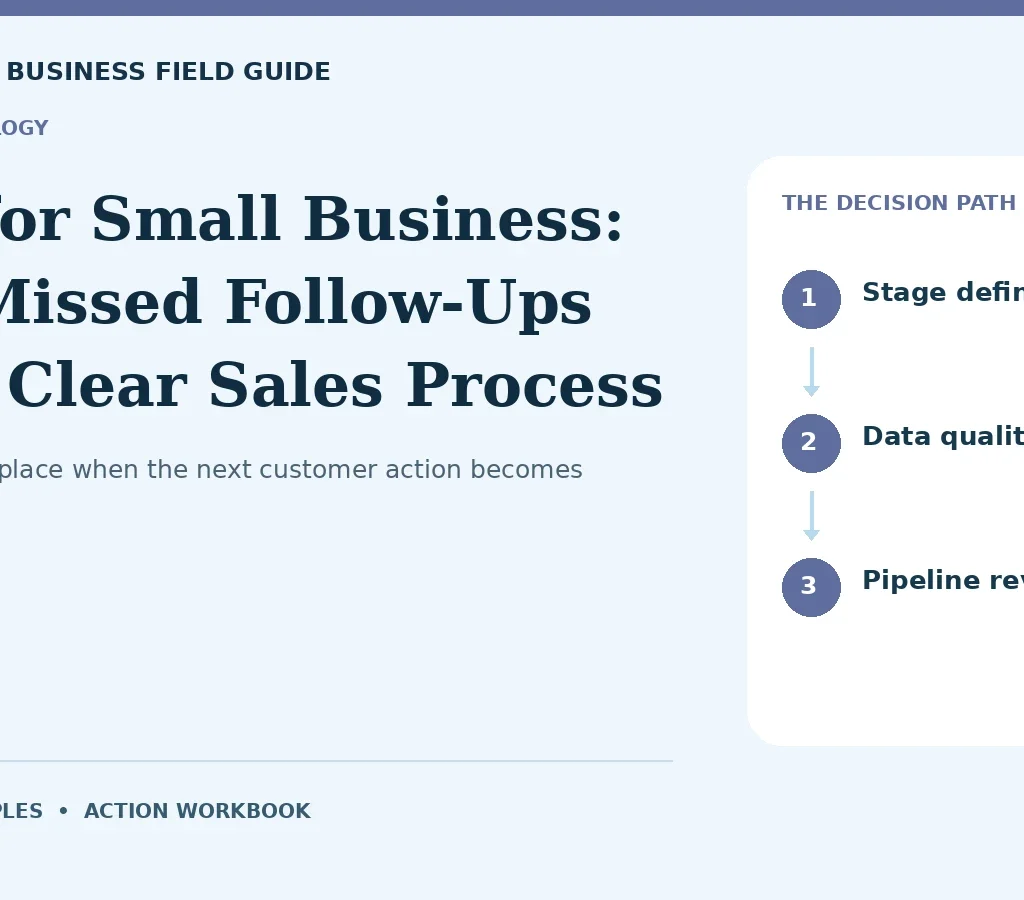
A CRM earns its place when the next customer action becomes obvious.
A small business rarely loses a sale because it lacks a colorful pipeline board. It loses sales because inquiries go unanswered, proposals have no next step, and nobody knows who owns the follow-up. A customer relationship management system should solve those problems. Before comparing software, define the customer journey and the minimum information required to manage it. This guide focuses on a practical CRM process for US owners and small teams. It avoids vendor rankings and treats the software as one part of a working sales routine.
Define stages with observable events
Use stages that mean something specific. New inquiry, qualified need, proposal sent, decision pending, won, and lost can work when each has entry and exit rules. Do not move an opportunity forward because a salesperson feels optimistic. Define the customer action or evidence required. Separate a person’s contact record from a sales opportunity if the system supports that distinction. One customer may have several purchases at different stages. Clear stages make pipeline reports easier to interpret and prevent a busy-looking board from hiding stalled conversations. Official reference: SBA: Business management and marketing resources.
Require a next action and an owner
Every active opportunity should have a responsible person and a dated next action. The action might be a discovery call, a quote revision, a customer decision check, or a purchase-order confirmation. Avoid vague notes such as follow up soon. Record the channel and reason for the contact. If the customer has asked not to be contacted, respect that request and your applicable obligations. The core value of a CRM is reducing uncertainty about what happens next. A reminder without meaningful context can still create poor customer communication.
Collect fewer fields more reliably
Start with contact details, source, need, stage, value where appropriate, owner, next action, and relevant consent or communication preferences. Add fields only when they support a decision or required process. Excessive mandatory fields can make staff avoid the system. Define how duplicates are handled and who can export records. Protect personal information and avoid storing sensitive details without a clear purpose. A small database with consistent records is more useful than a large database containing outdated phone numbers, unexplained labels, and copied private notes.
Connect marketing to qualified demand
Record inquiry source, but distinguish raw leads from qualified opportunities and completed purchases. A campaign generating many irrelevant inquiries may look successful until sales time is counted. Track response time and reasons for loss. Use those patterns to improve the offer, qualification, and landing page. Do not assume one touchpoint deserves all credit for a sale. A customer may encounter multiple channels. Keep attribution simple enough to maintain while acknowledging uncertainty. The CRM should help you learn where useful conversations begin rather than produce false precision.
Design integrations and handoffs
Decide how website forms, email, calendars, quotes, invoicing, and support systems connect. Identify the source of truth and what happens after a deal is marked won. A sales handoff should include the promised scope, timing, price, and customer expectations. Otherwise the delivery team must reconstruct the conversation. Test duplicates and failed connections. Start with one reliable integration before connecting everything. Automation is valuable when it preserves context and accountability; it is harmful when it sends the wrong message or creates tasks nobody understands.
Review the pipeline as a decision meeting
A weekly review should focus on stalled opportunities, overdue actions, changing customer needs, and realistic capacity. Avoid spending the meeting reading every record aloud. Ask what must happen for the next stage and what evidence supports the estimated value. Archive or close stale opportunities rather than keeping them forever. Measure adoption through updated next actions and useful records, not only login counts. A CRM becomes effective when the team trusts it enough to manage work from it and the owner uses it to remove obstacles.
A worked example
Illustrative example: a commercial cleaning company receives forty inquiries in a month. Twelve meet its service-area and scope criteria, eight receive proposals, and three become customers. A CRM reveals that several qualified inquiries waited four days for a response. The company improves ownership and response scheduling before buying more leads. If its marketing cost was $600, dividing by forty gives $15 per inquiry; dividing by three gives $200 per new customer. Those are different metrics. The fictional example shows why qualified demand and follow-up matter more than a large contact count.
Try your own numbers
Change the example inputs to explore this simple planning relationship.
Cost per new customer ($)Illustrative arithmetic only. This tool does not estimate taxes, loan eligibility, legal requirements, insurance coverage, or net profit. It uses no external service and does not store your inputs.
The worked example and formula above remain available without JavaScript.
Your action workbook
Use the following checkpoints as a working document, not a score that promises success. Each one connects a specific action to evidence and a warning sign. Review the items in sequence or start with the weakest area in your business. The checkboxes are a temporary reading aid; they do not save personal information or certify compliance. Keep any actual records securely in your own operating system. For questions involving legal, tax, lending, insurance, or employment obligations, obtain appropriate current guidance. Your final decision should reflect the evidence, the cost of being wrong, and the capacity to maintain the process after the initial setup.
01 Stage definitions
Establish the starting point. Write observable entry and exit rules for each sales stage. Keep this in a dated decision record. Assign any unresolved question to a responsible person before committing money or making a customer promise.
Evidence to keep: A short stage guide applied to sample opportunities.
Warning sign: Moving deals based only on salesperson optimism.
02 Ownership rule
Test before committing. Assign one responsible person for every active opportunity. Use a representative situation, record the result, and revise weak assumptions before expansion. A small test should inform the next decision, including when to pause.
Evidence to keep: A pipeline with no unowned records.
Warning sign: Assuming someone else will answer a promising inquiry.
03 Next action
Make the evidence retrievable. Require a specific task with a realistic date and purpose. Store the supporting record with its date and limitations. Compare new findings with the original assumption so changes remain visible to the next reviewer.
Evidence to keep: A task list connected to customer context.
Warning sign: Using vague reminders with no reason to contact the buyer.
04 Minimum data
Check the real-world constraint. Collect only fields supporting the workflow and obligations. Confirm the practical effect with the responsible operator or qualified adviser. Record whether it changes scope, timing, cost, or the ability to proceed.
Evidence to keep: Consistent records with useful communication preferences.
Warning sign: Creating so many required fields that staff avoid entry.
05 Data quality
Separate confirmation from expectation. Set duplicate, stale-record, and correction processes. Label unverified assumptions clearly. Obtain stronger evidence when the decision depends heavily on them, and avoid passing an expectation to others as a guarantee.
Evidence to keep: A cleanup log and accountable data owner.
Warning sign: Treating a large database as evidence of useful customer knowledge.
06 Lead qualification
Assign a usable next action. Separate inquiries from opportunities with a defined fit test. Name one responsible person and define completion. Record dependencies on other parties, then follow up through an appropriate verified channel rather than an informal assumption.
Evidence to keep: Qualification reasons and stage conversion counts.
Warning sign: Counting every contact as likely revenue.
07 Source tracking
Compare the alternatives fairly. Record where useful inquiries begin without overclaiming attribution. Use equivalent scope and timing. Record the tradeoff affecting your operation instead of selecting from a favorable headline whose underlying conditions may differ.
Evidence to keep: Campaign data connected to qualified conversations.
Warning sign: Optimizing for cheap leads that rarely become customers.
08 Sales handoff
Plan for the ordinary exception. Transfer scope, timing, price, and commitments to delivery. Consider delays, missing records, or weaker results. Decide who notices and what happens next so the process does not depend on an unwritten workaround.
Evidence to keep: A standard won-deal checklist.
Warning sign: Making operations reconstruct promises from scattered emails.
09 Automation test
Turn review into a decision. Test forms, reminders, and messages with realistic exceptions. Choose whether to continue, revise, or pause using the findings. Record the reason and the next review trigger rather than adding activity without resolving the constraint.
Evidence to keep: Verified triggers and failure handling.
Warning sign: Sending automated messages after a customer asks to stop.
10 Pipeline review
Maintain the improvement. Resolve stalled deals and overdue actions in a focused meeting. Review this after material changes. Keep ownership and current instructions clear, because a completed setup can become outdated as people, conditions, and the business evolve.
Evidence to keep: A weekly action record with closed stale opportunities.
Warning sign: Using a CRM as a decorative board that nobody updates.
Make the next decision
A useful CRM review asks what changed for the customer. Did inquiries receive a timely answer? Did the proposal reflect the actual need? Did delivery receive the promises made during sales? Use the system to make those handoffs visible. Keep a small number of meaningful fields and improve them before adding more automation. If the team avoids updates, investigate whether the process is too complicated or whether management ignores the information. Adoption is a shared management problem, not simply a request that staff type more notes. Review lost opportunities for patterns without treating every loss as a failure. Some buyers are a poor fit, and closing those records honestly improves the pipeline. The objective is a reliable next action and an accurate understanding of demand, rather than the largest possible list of active deals.
Frequently asked questions
Do I need CRM software immediately?
A simple maintained process may be enough at low volume. Software becomes useful when ownership, reminders, reporting, and handoffs become difficult to manage reliably.
Which metric should I watch first?
Start with response time, qualified inquiries, overdue next actions, and completed purchases. The right emphasis depends on where your sales process is losing momentum.
Continue with a related guide
Official sources and scope
Sources checked October 12, 2026. Official links support the regulatory and program checkpoints; the business examples, planning methods, and workbook are original editorial material. Rules, terms, and opportunities can change. This is general educational content; use current professional guidance for decisions specific to your business.