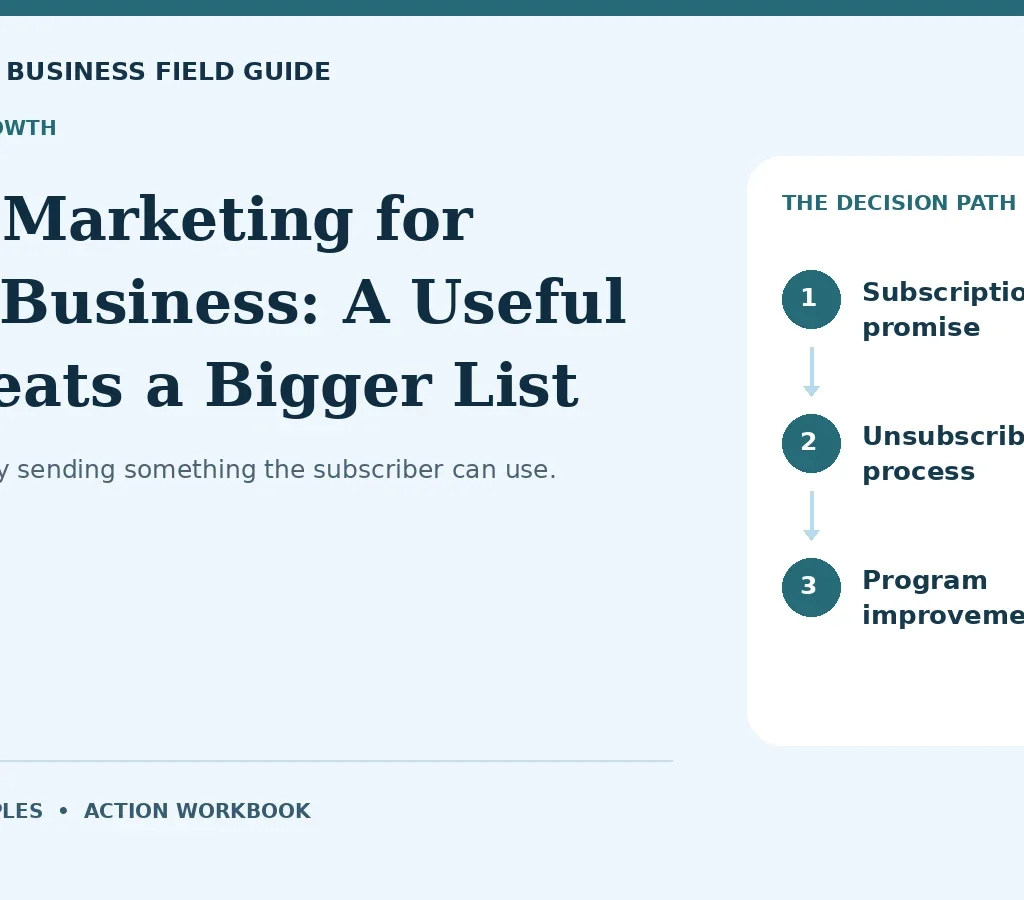
Earn attention by sending something the subscriber can use.
Email marketing is valuable when customers understand why they are receiving a message and find it worth opening. A large list assembled without care can create complaints, poor engagement, and wasted effort. Start with a clear audience promise: what will subscribers receive, how often, and why does it help them? This guide covers a practical US small-business program, including a brief compliance checkpoint. It does not replace legal advice or platform requirements. The editorial objective is simple: send fewer, more useful messages that lead to a sensible next step.
Define the reason to subscribe
Offer a specific benefit connected to your business: maintenance reminders, useful buying guidance, product availability updates, or a focused educational series. Avoid promising everything at once. Show the expected content and frequency near signup. Keep records appropriate to how contacts join and what preferences they express. A customer who purchases once does not necessarily want an unrelated stream of promotions. Design the list around an ongoing relationship. If you cannot explain why the next message is useful, the problem is the offer rather than the email platform.
Use a focused welcome sequence
A welcome message can confirm expectations, provide the promised resource, and identify a simple next action. Later messages should build understanding rather than repeat an immediate sales pitch. A local service business might explain preparation, scheduling, and common scope questions. A product business might help customers choose or use an item. Test the links and mobile layout. Make it clear who is writing and how to contact the business. Do not insert invented customer stories or misleading urgency to make a sequence seem more persuasive.
Keep the US compliance checkpoint visible
The FTC’s CAN-SPAM guide explains requirements for commercial email, including accurate sender information, nondeceptive subjects, identification, a valid postal address, and an effective opt-out method. Opt-out requests must be honored within the stated legal period, generally ten business days. Responsibility does not disappear because a vendor sends the messages. Review the official guide and applicable requirements for your situation. This is a concise checkpoint, not a complete legal analysis. Build the operational process so unsubscribes are respected and suppressed contacts are not casually imported again. Official reference: FTC: CAN-SPAM compliance guide.
Segment by useful differences
Group contacts only when the distinction changes the message. New prospects, active customers, lapsed customers, and different product interests may need different information. Avoid excessive segmentation that cannot be maintained. Use information collected appropriately and avoid sensitive profiling without a clear basis. A useful segment can be simple: customers who bought a product that needs periodic supplies. Explain how preferences can be updated. The goal is relevance and lower confusion, not increasingly elaborate tracking that your team cannot govern.
Measure actions beyond opens
Email-open data can be noisy because of privacy features and automated activity. Track clicks, replies, qualified inquiries, purchases, unsubscribes, and complaints with appropriate context. A high open count does not prove a campaign created profitable sales. Connect results to the message’s purpose. An educational email may aim to reduce support questions; a product announcement may aim to generate purchases. Compare like with like and avoid changing several major variables at once. Keep customer experience visible alongside short-term conversion.
Protect deliverability and trust
Use verified sending arrangements and the authentication guidance supplied by your email provider. Send consistently enough that subscribers recognize the relationship. Remove invalid addresses and investigate complaints. Avoid buying a list simply because the contacts appear to match your market. Test rendering, links, sender identity, and the unsubscribe process before a major send. Maintain a calendar with a useful topic and next action for each campaign. A smaller list that understands the relationship can be more valuable than a large audience that does not know why you are contacting it.
A worked example
Illustrative example: a specialty retailer sends a maintenance guide to 800 relevant subscribers. Fifty people click, twelve ask a product question, and six purchase. At $400 in campaign-related cost, the simple acquisition figure is about $66.67 per purchaser if all six are treated as new acquired customers. That attribution may be incomplete, so the owner also reviews repeat purchases and other touchpoints. The team checks unsubscribes and complaints rather than focusing only on revenue. These figures are fictional and are not benchmark conversion rates or a promise of email performance.
Try your own numbers
Change the example inputs to explore this simple planning relationship.
Campaign cost per customer ($)Illustrative arithmetic only. This tool does not estimate taxes, loan eligibility, legal requirements, insurance coverage, or net profit. It uses no external service and does not store your inputs.
The worked example and formula above remain available without JavaScript.
Your action workbook
Use the following checkpoints as a working document, not a score that promises success. Each one connects a specific action to evidence and a warning sign. Review the items in sequence or start with the weakest area in your business. The checkboxes are a temporary reading aid; they do not save personal information or certify compliance. Keep any actual records securely in your own operating system. For questions involving legal, tax, lending, insurance, or employment obligations, obtain appropriate current guidance. Your final decision should reflect the evidence, the cost of being wrong, and the capacity to maintain the process after the initial setup.
01 Subscription promise
Establish the starting point. State useful content, expected frequency, and sender identity. Keep this in a dated decision record. Assign any unresolved question to a responsible person before committing money or making a customer promise.
Evidence to keep: A signup page that matches the actual program.
Warning sign: Collecting addresses without explaining the relationship.
02 Contact records
Test before committing. Maintain appropriate signup and preference information. Use a representative situation, record the result, and revise weak assumptions before expansion. A small test should inform the next decision, including when to pause.
Evidence to keep: A traceable contact source and suppression process.
Warning sign: Importing old contacts with no understanding of their expectations.
03 Welcome sequence
Make the evidence retrievable. Deliver the promised resource and one relevant next step. Store the supporting record with its date and limitations. Compare new findings with the original assumption so changes remain visible to the next reviewer.
Evidence to keep: Tested messages with working links and clear context.
Warning sign: Starting every new relationship with repeated urgent sales pitches.
04 Compliance review
Check the real-world constraint. Check commercial-email requirements against the FTC guide. Confirm the practical effect with the responsible operator or qualified adviser. Record whether it changes scope, timing, cost, or the ability to proceed.
Evidence to keep: Accurate identity, address, opt-out, and operational responsibilities.
Warning sign: Assuming the email vendor carries all compliance responsibility.
05 Unsubscribe process
Separate confirmation from expectation. Test opt-out and prevent suppressed contacts from returning casually. Label unverified assumptions clearly. Obtain stronger evidence when the decision depends heavily on them, and avoid passing an expectation to others as a guarantee.
Evidence to keep: A completed test and documented suppression rules.
Warning sign: Reimporting unsubscribed addresses during database cleanup.
06 Useful segments
Assign a usable next action. Group contacts only when the difference changes the message. Name one responsible person and define completion. Record dependencies on other parties, then follow up through an appropriate verified channel rather than an informal assumption.
Evidence to keep: A small maintained set of meaningful audience rules.
Warning sign: Creating complex segments from unreliable data.
07 Content calendar
Compare the alternatives fairly. Plan helpful topics with clear customer actions. Use equivalent scope and timing. Record the tradeoff affecting your operation instead of selecting from a favorable headline whose underlying conditions may differ.
Evidence to keep: A calendar linked to real questions and products.
Warning sign: Sending simply because a weekly slot is empty.
08 Technical setup
Plan for the ordinary exception. Follow provider guidance for sender verification and authentication. Consider delays, missing records, or weaker results. Decide who notices and what happens next so the process does not depend on an unwritten workaround.
Evidence to keep: Confirmed settings and deliverability monitoring.
Warning sign: Using an unfamiliar sender arrangement without testing.
09 Outcome measurement
Turn review into a decision. Track relevant clicks, replies, inquiries, purchases, and complaints. Choose whether to continue, revise, or pause using the findings. Record the reason and the next review trigger rather than adding activity without resolving the constraint.
Evidence to keep: A report matching each message’s purpose.
Warning sign: Treating opens as a precise measure of business value.
10 Program improvement
Maintain the improvement. Review content quality and trust signals after campaigns. Review this after material changes. Keep ownership and current instructions clear, because a completed setup can become outdated as people, conditions, and the business evolve.
Evidence to keep: A change log based on customer response.
Warning sign: Increasing frequency while complaints and confusion rise.
Make the next decision
Evaluate the email program as a relationship, not merely a sequence of campaigns. For each message, state the reader's benefit and the action that would show it helped. If the benefit is unclear, revise the content before changing the subject line. Maintain a suppression process as carefully as the signup process. Keep a test contact that can verify the complete experience, including signup, welcome, preferences, and unsubscribe. Review replies because they can reveal needs that click reports miss. A subscriber asking a question is giving you material for a more useful next message. When a campaign underperforms, check audience fit, offer clarity, delivery, and timing before sending the same message more often. The goal is recognizable, useful communication that customers can control, supported by a process the business can maintain.
Frequently asked questions
Are open rates enough?
No. Privacy systems and automated activity can complicate interpretation. Review actions connected to the campaign purpose and customer feedback.
Can I buy a list and start sending?
Do not treat purchase as proof of a suitable customer relationship or compliance. Check applicable requirements, provider policies, contact expectations, and the reputational consequences before using any list.
Continue with a related guide
Official sources and scope
Sources checked October 12, 2026. Official links support the regulatory and program checkpoints; the business examples, planning methods, and workbook are original editorial material. Rules, terms, and opportunities can change. This is general educational content; use current professional guidance for decisions specific to your business.