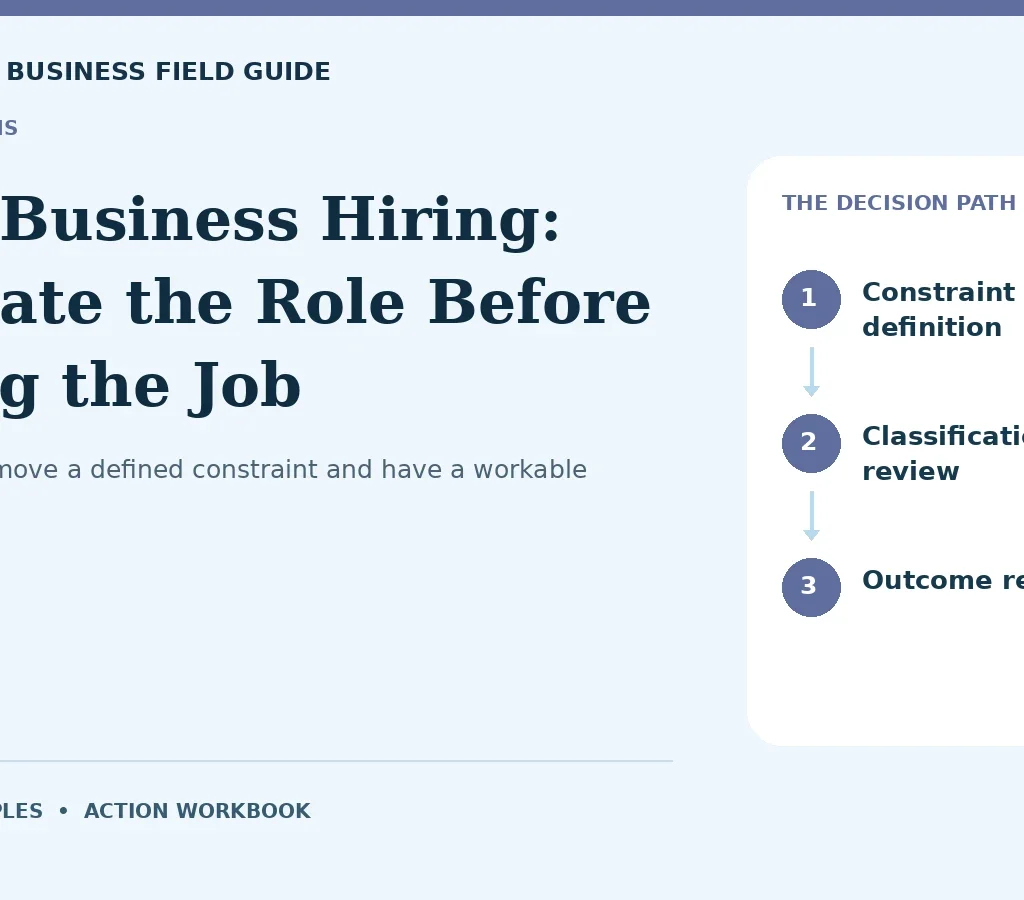
A hire should remove a defined constraint and have a workable support plan.
An owner who is overwhelmed may decide to hire someone before knowing which work the person should own. The result can be an expensive role with unclear expectations and little training. A useful hiring plan begins with a constraint: delayed customer responses, insufficient production capacity, inconsistent administration, or missing expertise. This guide helps US small businesses define that need and evaluate the cost. Employment rules, classification, payroll, and state requirements require current qualified guidance. The article is a management framework, not a legal determination about a worker.
Identify the work that should move
Track the owner’s and team’s activities for a representative period. Separate repetitive tasks, specialized work, and decisions that should remain with management. Define the bottleneck in observable terms: quote turnaround, missed calls, production backlog, or reconciliation delays. Hiring is not the only possible response. Process improvement, a narrower offer, better scheduling, or an appropriate outside service may remove the problem. If a new role is justified, explain what successful ownership looks like and what authority the person needs to accomplish it.
Calculate the full role cost
Wages or salary are only part of the budget. Consider employer obligations, benefits, recruitment, equipment, software, training, management time, and the ramp-up period as applicable. Ask your payroll and professional advisers which costs apply. Show when payments begin and how the business will fund them before productivity reaches the expected level. Do not justify a role solely with optimistic revenue. Use a downside case where training takes longer or demand is weaker. A hire should fit both operating economics and cash timing.
Address classification before engagement
Employee and independent-contractor classification is not resolved merely by calling someone a contractor or having them sign a document. The Department of Labor explains that the FLSA analysis concerns the economic realities of the relationship, while other legal and tax standards may also apply. Current rules and enforcement guidance should be reviewed for the actual arrangement. Avoid using a label to bypass obligations. Obtain qualified advice where there is uncertainty, particularly when the work is controlled, ongoing, or closely integrated into the business. Official reference: DOL: Employment relationship under the FLSA.
Write outcomes and boundaries
A job description should identify the role’s purpose, responsibilities, required capabilities, reporting line, and realistic work conditions. Separate genuine requirements from preferences. Define the outcomes to be reviewed after onboarding. For customer support, that might include accurate resolution and timely escalation rather than only the number of tickets closed. For operations, it might include reliable handoffs and fewer errors. Avoid promising autonomy while requiring approval for every decision. Clear boundaries help candidates assess the role and help the manager support performance.
Build onboarding as a delivery system
Prepare access, equipment, training, documented workflows, and a named person for questions. Start with the tasks the person will perform most often. Explain customer promises and common exceptions. Use demonstrations, supervised practice, and feedback rather than handing over a folder and hoping it is understood. Set realistic first-week and first-month expectations. Track where instructions are missing or contradictory. Onboarding reveals weaknesses in the business’s process as well as the employee’s learning needs. Fix those gaps instead of treating every misunderstanding as a personal failure.
Review the role with useful evidence
Measure whether the original constraint improves. A support hire should reduce unanswered inquiries without creating poor-quality responses. An operations hire should improve reliable capacity, not merely increase hours worked. Review workload, training, manager availability, and customer outcomes. Ask the employee what obstacles remain. Adjust the process and responsibilities when evidence supports it. A successful hire depends on management quality and a viable role. Recruitment alone cannot repair a broken operating model or an owner unwilling to delegate necessary authority.
A worked example
Illustrative example: a service business considers a coordinator earning $3,200 monthly. It budgets an additional hypothetical $800 for applicable employer costs, equipment, and support, creating a $4,000 monthly planning amount. At $100 contribution per additional completed job, forty additional jobs would cover that amount before other effects. The company tests whether enough demand exists and whether the coordinator can realistically remove the scheduling bottleneck. These figures are invented and do not represent statutory cost rates or a market salary. They show why role economics and implementation should be examined together.
Try your own numbers
Change the example inputs to explore this simple planning relationship.
Additional jobs requiredIllustrative arithmetic only. This tool does not estimate taxes, loan eligibility, legal requirements, insurance coverage, or net profit. It uses no external service and does not store your inputs.
The worked example and formula above remain available without JavaScript.
Your action workbook
Use the following checkpoints as a working document, not a score that promises success. Each one connects a specific action to evidence and a warning sign. Review the items in sequence or start with the weakest area in your business. The checkboxes are a temporary reading aid; they do not save personal information or certify compliance. Keep any actual records securely in your own operating system. For questions involving legal, tax, lending, insurance, or employment obligations, obtain appropriate current guidance. Your final decision should reflect the evidence, the cost of being wrong, and the capacity to maintain the process after the initial setup.
01 Constraint definition
Establish the starting point. Identify the delayed or unreliable work the role should improve. Keep this in a dated decision record. Assign any unresolved question to a responsible person before committing money or making a customer promise.
Evidence to keep: A baseline of turnaround, backlog, or error rates.
Warning sign: Hiring because everyone feels busy without defining the problem.
02 Task design
Test before committing. Separate transferable tasks from specialized work and management decisions. Use a representative situation, record the result, and revise weak assumptions before expansion. A small test should inform the next decision, including when to pause.
Evidence to keep: A responsibility map with clear ownership.
Warning sign: Delegating accountability without necessary authority.
03 Alternative review
Make the evidence retrievable. Check whether process changes or narrower scope resolve the constraint. Store the supporting record with its date and limitations. Compare new findings with the original assumption so changes remain visible to the next reviewer.
Evidence to keep: A comparison of realistic options.
Warning sign: Assuming recruitment is the only way to improve capacity.
04 Full cost
Check the real-world constraint. Budget compensation, applicable obligations, tools, training, and management time. Confirm the practical effect with the responsible operator or qualified adviser. Record whether it changes scope, timing, cost, or the ability to proceed.
Evidence to keep: A role cash plan reviewed by relevant advisers.
Warning sign: Budgeting only the advertised salary.
05 Classification review
Separate confirmation from expectation. Assess the actual relationship under applicable standards. Label unverified assumptions clearly. Obtain stronger evidence when the decision depends heavily on them, and avoid passing an expectation to others as a guarantee.
Evidence to keep: Qualified advice and documented arrangement details.
Warning sign: Believing a contractor label settles every legal question.
06 Job description
Assign a usable next action. Write purpose, outcomes, responsibilities, and genuine requirements. Name one responsible person and define completion. Record dependencies on other parties, then follow up through an appropriate verified channel rather than an informal assumption.
Evidence to keep: A clear document candidates can evaluate.
Warning sign: Listing every possible skill without a coherent role.
07 Selection process
Compare the alternatives fairly. Use relevant evidence and a consistent assessment approach. Use equivalent scope and timing. Record the tradeoff affecting your operation instead of selecting from a favorable headline whose underlying conditions may differ.
Evidence to keep: Documented role-related evaluation criteria.
Warning sign: Choosing solely on personal familiarity or polished presentation.
08 Onboarding preparation
Plan for the ordinary exception. Prepare access, equipment, workflows, and a training owner. Consider delays, missing records, or weaker results. Decide who notices and what happens next so the process does not depend on an unwritten workaround.
Evidence to keep: A first-month plan with supervised practice.
Warning sign: Expecting productivity before tools and instructions are ready.
09 Manager support
Turn review into a decision. Provide feedback and remove process obstacles. Choose whether to continue, revise, or pause using the findings. Record the reason and the next review trigger rather than adding activity without resolving the constraint.
Evidence to keep: Scheduled reviews and resolved blockers.
Warning sign: Interpreting every unclear instruction as poor performance.
10 Outcome review
Maintain the improvement. Compare results with the original constraint and cost assumptions. Review this after material changes. Keep ownership and current instructions clear, because a completed setup can become outdated as people, conditions, and the business evolve.
Evidence to keep: A role review using quality, capacity, and cash evidence.
Warning sign: Counting hours worked as proof the hire improved the business.
Make the next decision
Before posting the job, write a role decision memo covering the constraint, transferable work, authority, total cost, support plan, and review date. If the role is expected to increase revenue, explain the demand and capacity assumptions. If it is expected to reduce risk or improve reliability, choose evidence appropriate to that purpose rather than forcing a sales target. During onboarding, compare the instructions with what the person actually encounters. Fix missing access, contradictory procedures, and unrealistic workloads early. A new employee should not have to infer every customer promise from scattered conversations. After the first month, assess both performance and management support. The hire may need more training, a clearer boundary, or a redesigned process. A defined role with workable support is more likely to relieve the owner than a vague request to help with everything.
Frequently asked questions
Can I call the person a contractor to simplify payroll?
A label does not settle classification. The actual relationship and applicable federal, state, and tax standards matter. Review current guidance and obtain qualified advice.
When is the right time to hire?
When the work is defined, the role can be supported, and the full cost fits a realistic cash plan. A persistent constraint is useful evidence, but it should be tested against other solutions.
Continue with a related guide
Official sources and scope
Sources checked October 12, 2026. Official links support the regulatory and program checkpoints; the business examples, planning methods, and workbook are original editorial material. Rules, terms, and opportunities can change. This is general educational content; use current professional guidance for decisions specific to your business.