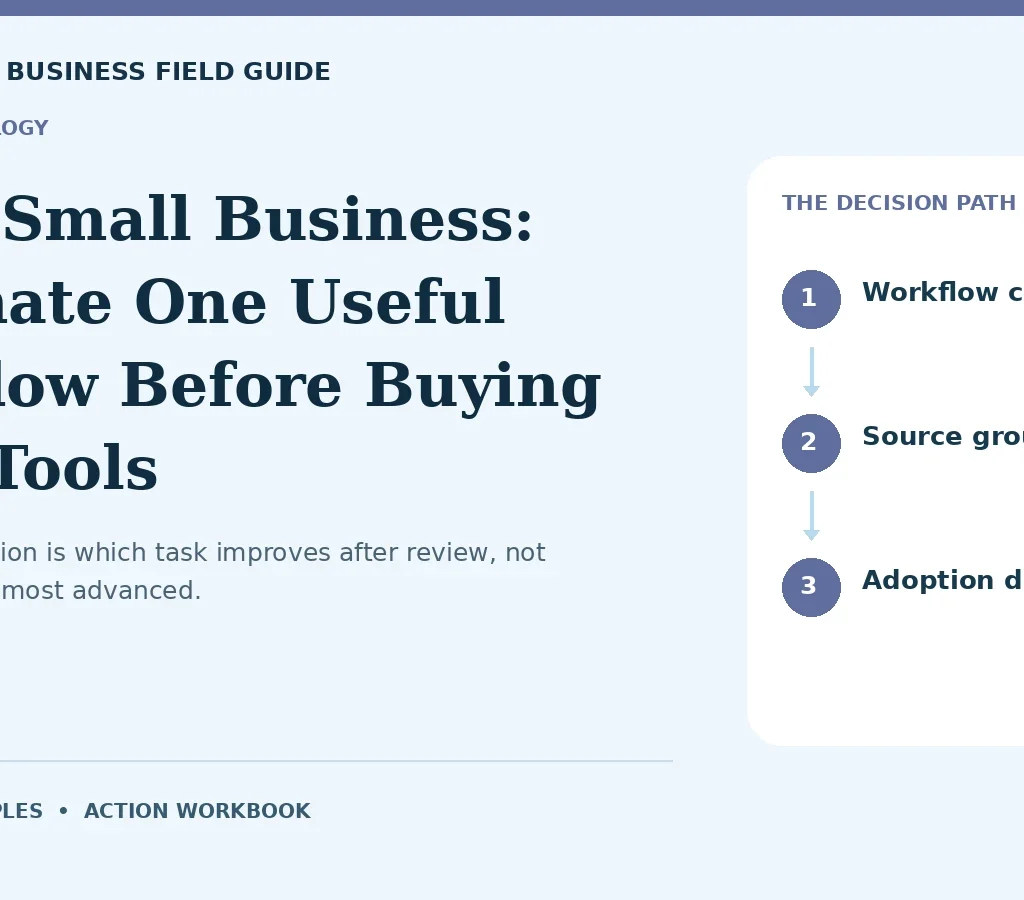
The useful question is which task improves after review, not which tool looks most advanced.
AI can help a small business draft, summarize, organize, and analyze work. It can also produce confident mistakes, expose information through poor practices, and create another subscription nobody maintains. Start with one low-risk workflow that has a clear baseline and a human reviewer. This guide helps US owners evaluate that workflow without assuming a particular product or promising a productivity increase. The goal is a controlled improvement you can measure. A useful pilot may end with adoption, revision, or a decision that the tool does not yet fit.
Select a bounded task
Choose work that is repetitive, reviewable, and not dependent on unrestricted authority. Examples include drafting an internal meeting summary, organizing non-sensitive product notes, or preparing a first version of a customer FAQ from approved information. Avoid beginning with automatic legal, financial, hiring, or medical decisions. Write the input, output, reviewer, and success measure. A broad goal such as use AI everywhere is difficult to test. A narrow task gives you a baseline and makes mistakes easier to identify before they reach customers.
Measure the existing process
Record how long the task takes, how often it occurs, what errors happen, and what quality standard matters. Include review and correction time. A tool that drafts quickly but requires extensive checking may save less time than expected. Compare equivalent tasks rather than a carefully selected demonstration with an unusually difficult manual job. The baseline need not be perfect, but it should be honest. Identify whether the task is actually a bottleneck or merely an activity that looks easy to automate.
Set data and access boundaries
Decide which information can be entered and which requires approval or must stay out. Review the provider’s current data, retention, and security terms for your arrangement. Avoid uploading customer secrets, credentials, or sensitive employee information casually. Define who can use the tool and who owns the account. The SBA’s AI guidance discusses benefits and risks; your business still needs its own controls. A convenient interface does not answer every privacy, contractual, or security question. Seek qualified support for higher-risk data and workflows. Official reference: SBA: AI benefits and risks.
Ground outputs in approved material
Give the system the relevant source information and require it to distinguish confirmed facts from missing information. A customer reply should use the actual policy rather than invent a favorable answer. A product description should not fabricate certifications, compatibility, or performance claims. Keep a reviewer accountable for the final output. Test examples with ambiguity and missing data. Ask what the workflow does when it cannot answer safely. The desired behavior may be a question or escalation rather than a polished response.
Evaluate errors and business impact
Score outputs for accuracy, completeness, clarity, and required corrections. Track serious errors separately from cosmetic edits. A pilot that saves ten minutes but creates a misleading customer claim may not be worthwhile. Review the effect on the entire process, including handoffs and support. Keep a record of examples that failed and update instructions or scope. Do not treat the absence of a problem in a small test as proof that the workflow is safe in every situation. Expand gradually with appropriate monitoring.
Adopt with ownership and an exit path
If the pilot works, document instructions, approved inputs, review requirements, and the person maintaining it. Include subscription costs, training, monitoring, and fallback procedures in the decision. Keep essential business knowledge accessible outside a single tool. Set a review trigger for model, policy, data, or workflow changes. The right outcome is a maintained process that improves useful work. More automation is not automatically better; reducing unnecessary steps or using a conventional template may be the simpler solution for some tasks.
A worked example
Illustrative example: a company prepares twenty weekly customer-summary notes. Each previously took twelve minutes. An AI-assisted process takes four minutes to draft and three minutes to review and correct, saving five minutes per note. That is 100 minutes per week, not the 160 minutes implied by counting draft speed alone. At an internal time value of $30 per hour, the simple weekly time value is $50 before subscription, training, and monitoring costs. These fictional figures are a measurement example, not a prediction of AI performance or a claim that all saved time becomes cash profit.
Try your own numbers
Change the example inputs to explore this simple planning relationship.
Weekly minutes savedIllustrative arithmetic only. This tool does not estimate taxes, loan eligibility, legal requirements, insurance coverage, or net profit. It uses no external service and does not store your inputs.
The worked example and formula above remain available without JavaScript.
Your action workbook
Use the following checkpoints as a working document, not a score that promises success. Each one connects a specific action to evidence and a warning sign. Review the items in sequence or start with the weakest area in your business. The checkboxes are a temporary reading aid; they do not save personal information or certify compliance. Keep any actual records securely in your own operating system. For questions involving legal, tax, lending, insurance, or employment obligations, obtain appropriate current guidance. Your final decision should reflect the evidence, the cost of being wrong, and the capacity to maintain the process after the initial setup.
01 Workflow choice
Establish the starting point. Select one bounded task with reviewable outputs and limited authority. Keep this in a dated decision record. Assign any unresolved question to a responsible person before committing money or making a customer promise.
Evidence to keep: A defined input, output, reviewer, and success measure.
Warning sign: Starting with autonomous high-stakes decisions.
02 Baseline timing
Test before committing. Measure current effort including review and correction. Use a representative situation, record the result, and revise weak assumptions before expansion. A small test should inform the next decision, including when to pause.
Evidence to keep: Representative task samples and quality expectations.
Warning sign: Comparing a staged demonstration with unrelated manual work.
03 Data permission
Make the evidence retrievable. Identify information that may be used and what requires approval. Store the supporting record with its date and limitations. Compare new findings with the original assumption so changes remain visible to the next reviewer.
Evidence to keep: A documented data boundary and relevant provider terms.
Warning sign: Uploading sensitive records because the tool accepts them.
04 Account governance
Check the real-world constraint. Assign ownership, permissions, and maintenance responsibility. Confirm the practical effect with the responsible operator or qualified adviser. Record whether it changes scope, timing, cost, or the ability to proceed.
Evidence to keep: A controlled access list and departure process.
Warning sign: Using personal accounts for essential company workflows without governance.
05 Source grounding
Separate confirmation from expectation. Provide approved facts and require uncertainty to remain visible. Label unverified assumptions clearly. Obtain stronger evidence when the decision depends heavily on them, and avoid passing an expectation to others as a guarantee.
Evidence to keep: Outputs checked against actual policies and product records.
Warning sign: Allowing the system to invent missing customer promises.
06 Exception testing
Assign a usable next action. Test incomplete, ambiguous, and unusual inputs. Name one responsible person and define completion. Record dependencies on other parties, then follow up through an appropriate verified channel rather than an informal assumption.
Evidence to keep: A failure log with escalation behavior.
Warning sign: Piloting only easy examples that always look impressive.
07 Human review
Compare the alternatives fairly. Keep an accountable reviewer for consequential external output. Use equivalent scope and timing. Record the tradeoff affecting your operation instead of selecting from a favorable headline whose underlying conditions may differ.
Evidence to keep: A practical review checklist and correction record.
Warning sign: Calling an output verified because it sounds confident.
08 Savings calculation
Plan for the ordinary exception. Include drafting, checking, training, and monitoring effort. Consider delays, missing records, or weaker results. Decide who notices and what happens next so the process does not depend on an unwritten workaround.
Evidence to keep: A before-and-after process comparison.
Warning sign: Treating faster first drafts as the entire productivity gain.
09 Fallback plan
Turn review into a decision. Maintain instructions and essential knowledge outside the tool. Choose whether to continue, revise, or pause using the findings. Record the reason and the next review trigger rather than adding activity without resolving the constraint.
Evidence to keep: A usable manual or alternative process.
Warning sign: Letting a subscription outage stop the whole operation.
10 Adoption decision
Maintain the improvement. Review accuracy, usefulness, cost, and risk before expanding. Review this after material changes. Keep ownership and current instructions clear, because a completed setup can become outdated as people, conditions, and the business evolve.
Evidence to keep: A documented adopt, revise, or stop conclusion.
Warning sign: Adding more tools before the first workflow demonstrates value.
Make the next decision
Document the pilot so another person can reproduce it. Save the approved task, permitted inputs, instructions, review checklist, failed examples, timing results, and fallback process. If the tool or underlying model changes, repeat the consequential tests instead of assuming behavior remains identical. Review whether the task still needs the same workflow; sometimes the pilot reveals that a better template or clearer source document solves much of the problem. Keep the adoption decision reversible where practical. Avoid committing essential knowledge exclusively to a service the business does not control. A useful AI process has an accountable owner and an understood boundary. Its value is demonstrated in accurate, maintainable work after review, rather than in an impressive first draft or a general promise that every task can be automated.
Frequently asked questions
Can AI replace all human review?
This guide does not support that assumption. Review needs depend on consequences, accuracy, data, and the workflow. Start with accountable human checks and expand only with evidence and appropriate controls.
Do time savings equal profit?
Not automatically. Saved time can create capacity or improve responsiveness, but subscription, review, training, and monitoring still cost money. The business must use the capacity productively to create financial value.
Continue with a related guide
Official sources and scope
Sources checked October 12, 2026. Official links support the regulatory and program checkpoints; the business examples, planning methods, and workbook are original editorial material. Rules, terms, and opportunities can change. This is general educational content; use current professional guidance for decisions specific to your business.