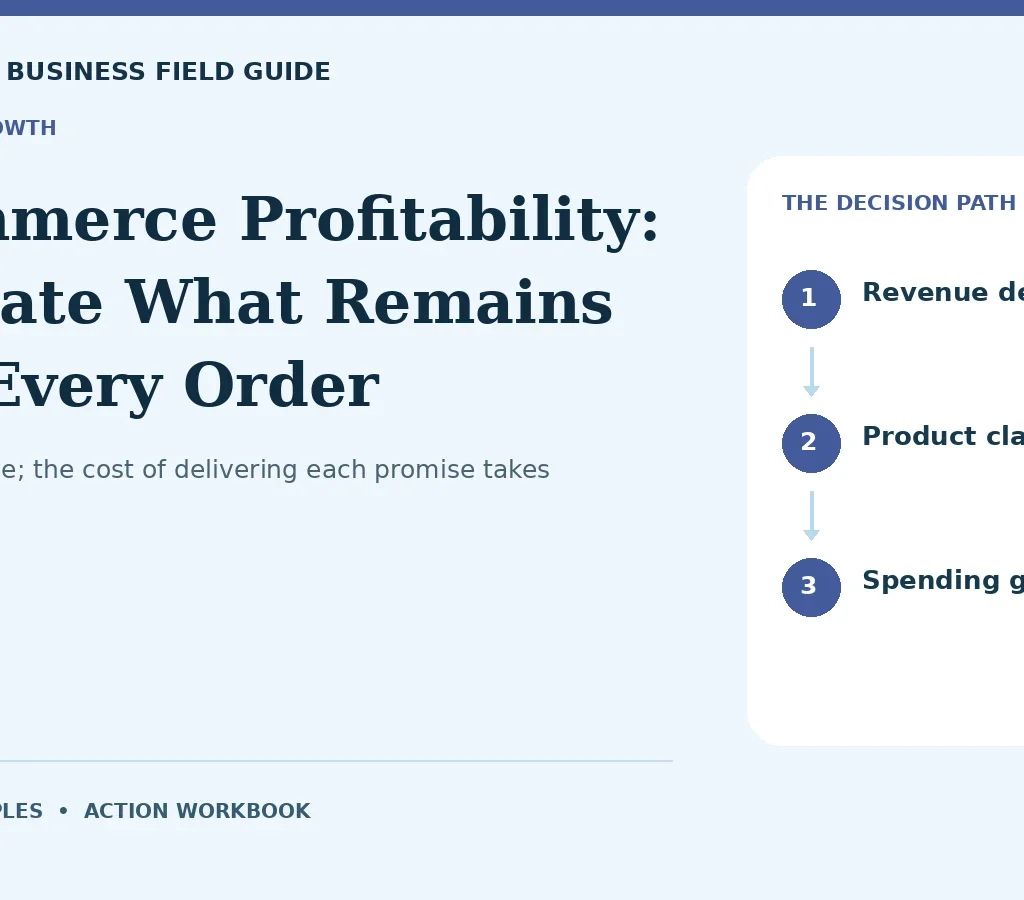
Revenue is visible; the cost of delivering each promise takes more work.
An online store can grow sales while earning less from each order. Advertising, shipping, payment fees, discounts, returns, and support may consume the margin that looked attractive at purchase. E-commerce profitability begins with a complete order model and a reliable customer promise. This guide helps US product businesses examine both. It does not promise a conversion rate or recommend a particular platform. The useful question is what remains from an order after the costs required to acquire, fulfill, and support it.
Build a complete order cost stack
Start with selling price and any shipping revenue, then identify product cost, packaging, picking, shipping expense, payment fees, expected returns, and other variable costs. Keep taxes collected for authorities separate from revenue where appropriate to your accounting treatment. State how discounts are handled. An average order value is useful only when the cost stack corresponds to that average. Review several representative order types: a single item, a bundle, a heavy parcel, and an order likely to be returned. Different baskets can have very different economics.
Separate acquisition from fulfillment
Calculate contribution before marketing, then examine the acquisition spending required to obtain customers. Distinguish new-customer acquisition from campaigns aimed at existing customers. Avoid dividing all advertising spending by all orders if that creates a misleading picture. Attribution is imperfect, so maintain a consistent method and disclose its limits. A return on ad spend figure compares revenue with advertising spend; it does not automatically show profit. Product and delivery costs still exist. Use contribution and cash alongside campaign reports.
Make the product page answer real questions
Explain dimensions, materials, compatibility, contents, usage, delivery expectations, and relevant limitations. Use accurate images and do not imply accessories are included if they are not. Clear information can reduce wrong-fit purchases and support inquiries. Reviews should reflect real experiences and be handled responsibly. Avoid manufacturing urgency or presenting an invented reference price as a genuine discount. Conversion improvements are valuable when they create suitable purchases, not when they push customers into misunderstanding the product.
Support shipping promises with evidence
The FTC’s merchandise-order rule requires a reasonable basis for advertised shipping timeframes and provides rules for delays and refunds. Review the official business guide for the applicable details. Connect the website promise to available stock, warehouse capacity, and carrier arrangements. Shipping and delivery are different events, so communicate carefully. If a delay occurs, follow a compliant process rather than quietly changing the order status. Accurate promises protect customers and reduce avoidable support and refund problems. A fast-looking claim is not useful if operations cannot support it. Official reference: FTC: Merchandise-order business guide.
Model returns and support
Returns affect shipping, processing, inventory condition, refund timing, and acquisition economics. Track reasons rather than treating every return as an unavoidable percentage. Wrong size, unclear imagery, damage, and delayed fulfillment call for different responses. Make the policy understandable and confirm applicable requirements. Estimate support workload for common questions. A product with strong initial margin may become less attractive after repeated troubleshooting. Use actual data to improve the cost model and page content. Do not assume that preventing customer contact is the same as reducing support cost.
Scale only after the unit model works
Before increasing advertising or inventory, confirm that the offer generates acceptable contribution, the fulfillment process is reliable, and cash timing is manageable. Growth may require paying suppliers before revenue arrives. Test a downside case with weaker conversion, higher shipping, or more returns. Define a campaign stop rule and an inventory gate. Scaling an unprofitable order multiplies the loss. Scaling a profitable order without enough working capital can still create a crisis. The operating model and cash forecast should guide the next spending decision.
A worked example
Illustrative example: a store collects $90 for an order. Product cost is $35, fulfillment and packaging total $12, payment costs are $3, and an expected returns/support allowance is $5. Contribution before acquisition is $35. If attributable acquisition spending is $25 per new customer, $10 remains before fixed overhead and other business needs. A $10 discount could consume that remaining amount if the other costs stay unchanged. These figures are invented and are not industry benchmarks, tax advice, or a claim that the order produces $10 of net profit.
Try your own numbers
Change the example inputs to explore this simple planning relationship.
Order contribution ($)Illustrative arithmetic only. This tool does not estimate taxes, loan eligibility, legal requirements, insurance coverage, or net profit. It uses no external service and does not store your inputs.
The worked example and formula above remain available without JavaScript.
Your action workbook
Use the following checkpoints as a working document, not a score that promises success. Each one connects a specific action to evidence and a warning sign. Review the items in sequence or start with the weakest area in your business. The checkboxes are a temporary reading aid; they do not save personal information or certify compliance. Keep any actual records securely in your own operating system. For questions involving legal, tax, lending, insurance, or employment obligations, obtain appropriate current guidance. Your final decision should reflect the evidence, the cost of being wrong, and the capacity to maintain the process after the initial setup.
01 Revenue definition
Establish the starting point. Identify product revenue, shipping revenue, discounts, and relevant tax treatment. Keep this in a dated decision record. Assign any unresolved question to a responsible person before committing money or making a customer promise.
Evidence to keep: A consistent order model reviewed with accounting guidance.
Warning sign: Counting every checkout dollar as business revenue.
02 Cost stack
Test before committing. Record product, packaging, picking, shipping, fees, and variable support. Use a representative situation, record the result, and revise weak assumptions before expansion. A small test should inform the next decision, including when to pause.
Evidence to keep: Representative completed-order cost sheets.
Warning sign: Ignoring fulfillment because it occurs outside the storefront.
03 Basket differences
Make the evidence retrievable. Compare single-item, bundle, heavy, and return-prone orders. Store the supporting record with its date and limitations. Compare new findings with the original assumption so changes remain visible to the next reviewer.
Evidence to keep: Contribution estimates by meaningful order type.
Warning sign: Applying one average to baskets with very different costs.
04 Acquisition model
Check the real-world constraint. Separate new-customer spending from existing-customer activity. Confirm the practical effect with the responsible operator or qualified adviser. Record whether it changes scope, timing, cost, or the ability to proceed.
Evidence to keep: A consistent attribution method with stated limitations.
Warning sign: Treating ad-reported revenue as proof of profit.
05 Product clarity
Separate confirmation from expectation. Explain specifications, contents, compatibility, and limitations. Label unverified assumptions clearly. Obtain stronger evidence when the decision depends heavily on them, and avoid passing an expectation to others as a guarantee.
Evidence to keep: A page tested against real pre-purchase questions.
Warning sign: Using attractive imagery that misrepresents included products.
06 Shipping promise
Assign a usable next action. Match advertised timing to stock and operational capacity. Name one responsible person and define completion. Record dependencies on other parties, then follow up through an appropriate verified channel rather than an informal assumption.
Evidence to keep: A documented basis and compliant delay process.
Warning sign: Promising fast shipment without evidence the team can deliver.
07 Return analysis
Compare the alternatives fairly. Track reasons, condition, processing cost, and refund timing. Use equivalent scope and timing. Record the tradeoff affecting your operation instead of selecting from a favorable headline whose underlying conditions may differ.
Evidence to keep: A return log linked to product and fulfillment improvements.
Warning sign: Using a flat allowance without investigating repeated causes.
08 Support design
Plan for the ordinary exception. Provide useful answers and a reachable resolution process. Consider delays, missing records, or weaker results. Decide who notices and what happens next so the process does not depend on an unwritten workaround.
Evidence to keep: A record of common questions and handling effort.
Warning sign: Hiding contact options to make support costs look smaller.
09 Growth scenario
Turn review into a decision. Test weaker conversion, higher costs, and slower cash collection. Choose whether to continue, revise, or pause using the findings. Record the reason and the next review trigger rather than adding activity without resolving the constraint.
Evidence to keep: A downside unit and cash model.
Warning sign: Scaling advertising from revenue alone.
10 Spending gates
Maintain the improvement. Define campaign limits and inventory commitments based on evidence. Review this after material changes. Keep ownership and current instructions clear, because a completed setup can become outdated as people, conditions, and the business evolve.
Evidence to keep: A go, revise, or pause decision for each expansion.
Warning sign: Increasing spend because the sales dashboard looks exciting.
Make the next decision
Before scaling the store, review one complete customer journey from advertisement to delivery and possible return. Compare what the campaign promises, what the product page shows, what checkout charges, and what fulfillment actually delivers. Misalignment at any step can create support costs and lost trust. Keep the contribution model connected to actual order data rather than a theoretical basket. Evaluate new-customer economics and repeat behavior separately, with honest attribution limits. Set a campaign stop rule and a working-capital check before committing more funds. If the store's model works only when returns never occur or advertising remains unusually cheap, it needs further testing. Sustainable growth comes from a suitable offer, reliable delivery, understandable policies, and economics that remain workable when ordinary exceptions happen.
Frequently asked questions
Does high ROAS mean the store is profitable?
No. ROAS compares revenue with ad spending. Product costs, fulfillment, fees, returns, support, and overhead can still consume the apparent gain.
Should I offer free shipping?
Model the shipping expense, basket behavior, conversion, and contribution. The shipping label may be free to the customer while remaining a real cost to the business.
Continue with a related guide
Official sources and scope
Sources checked October 12, 2026. Official links support the regulatory and program checkpoints; the business examples, planning methods, and workbook are original editorial material. Rules, terms, and opportunities can change. This is general educational content; use current professional guidance for decisions specific to your business.