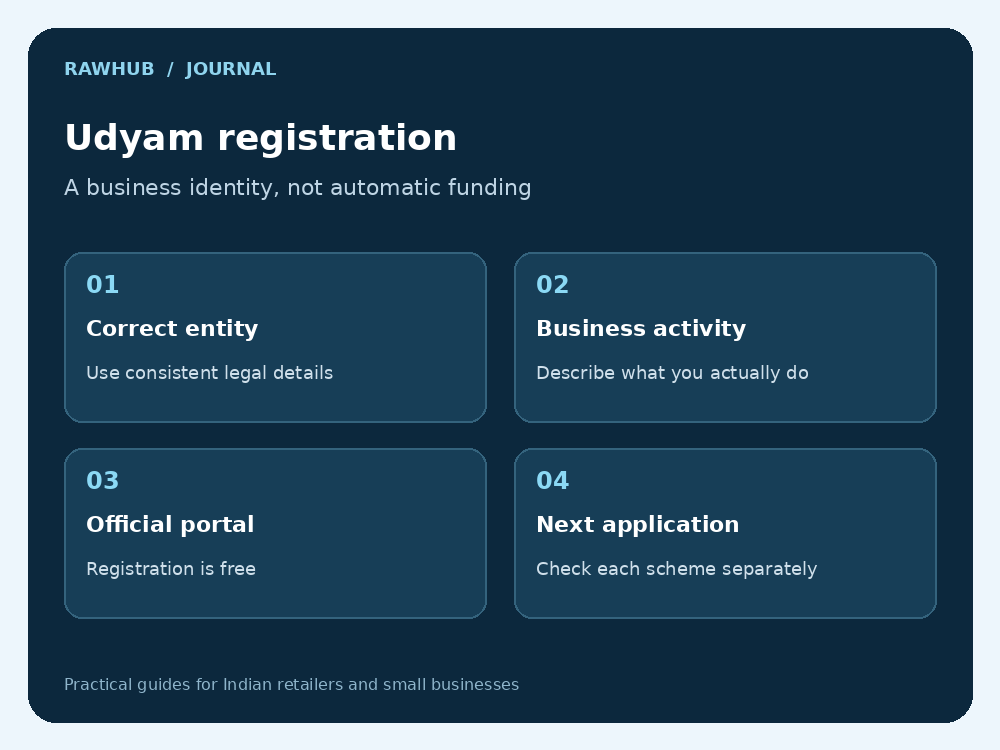
Udyam registration gives an eligible enterprise an MSME identity, but it does not automatically approve a loan, subsidy or government contract. That distinction matters for a retailer, wholesaler or LLP preparing to grow. The useful starting point is to record the correct legal entity and genuine business activities, then assess each benefit separately.
Many business owners search for an “MSME certificate” only when a bank or buyer asks for one. They then discover differences between the name on their invoice, bank account and incorporation records. A little preparation can prevent avoidable confusion. This guide explains how to organise that preparation, interpret the classification information and use the resulting registration responsibly in financing and supplier discussions.
- Identify the correct enterprise.
- Prepare consistent business details.
- Use the official registration channel.
- Verify and preserve the certificate.
- Check individual scheme or lender eligibility.
A certificate supports identification. Commercial due diligence still matters.
What the official Udyam portal says
The official portal states that registration is free, online and based on self-declaration. It provides a permanent registration number and an electronic certificate; renewal is not required. Its classification from 1 April 2025 uses both investment and turnover limits: micro up to ₹2.5 crore investment and ₹10 crore turnover; small up to ₹25 crore and ₹100 crore; medium up to ₹125 crore and ₹500 crore.
The portal also explains that one enterprise should not file multiple Udyam registrations merely to cover different activities. Multiple activities can be included within one registration. For an LLP, the organisation or authorised signatory must provide the relevant PAN, GSTIN and Aadhaar information under the applicable requirements. Refer to the official instructions for your constitution and tax circumstances rather than treating a general checklist as a substitute.
Start by identifying the legal applicant
A brand name and a legal entity are not always identical. A shop may trade under a familiar local name while its bank account and tax records use the proprietor’s details. An LLP has a separate legal name recorded in its incorporation documents. Write down the entity that actually purchases goods, issues invoices, receives payments and enters contracts. That is the identity around which the records should be organised.
For a multi-partner business, confirm who is authorised to provide information and handle the registration. Keep an internal record of that authority where appropriate. Do not casually reuse a partner’s personal business registration for a separate LLP. If activities have moved from one entity to another, seek guidance on the correct treatment. A convenient shortcut today can create inconsistent records when the bank reviews the business later.
Describe what the business really does
Prepare a plain-language list of actual activities. A cosmetics retailer sells finished goods to consumers; a wholesaler supplies other businesses; a manufacturer transforms inputs into products. A marketplace may facilitate transactions without manufacturing or owning every item listed. Those distinctions affect how you describe the enterprise and which activity classifications may be appropriate.
Choose descriptions based on operations, not the benefits you hope to obtain. If a company plans a new activity but has not started it, keep that distinction clear in applications and supporting explanations. For a business with multiple lines, maintain a short activity register and update it when operations change. Ask the official facilitation channel or your professional adviser if a classification is unclear rather than selecting an unrelated category.
Make your basic records consistent
Compare the legal name, address and contact details across incorporation or constitution documents, PAN records, business bank information and relevant tax registration. Write down any differences and the reason. A spelling variation or old address may be fixable, but it is better to identify it before submitting several applications that repeat the inconsistency.
Use contact details that the authorised business team can maintain. Losing access to an old phone number or email account can complicate later updates. Establish who keeps registration acknowledgements and where the business stores them. A secure shared business record is more reliable than leaving the only copy in one person’s message history, especially when partners divide operational responsibilities.
Free registration does not mean every outside service is official
Check the address of the official portal before entering information. Search advertisements and lookalike pages can make a paid intermediary appear to be the government service. Distinguish government registration from optional professional help. If you pay someone for advice, understand exactly what the fee covers and do not mistake that payment for an official registration charge.
Never share account passwords or one-time codes with an unsolicited caller. Keep sensitive identity information limited to legitimate processes and authorised advisers. Save the acknowledgement and verify the resulting certificate through the official facilities. If something looks wrong, seek correction through the proper channel. Buying a second certificate from another website does not resolve inconsistent data in the original registration.
How to think about classification
MSME classification depends on the applicable rules and data, not the size that looks most attractive in a sales presentation. Keep investment and turnover concepts separate from cash in the bank, outstanding loans or the market value of the whole business. When preparing a finance proposal, use the classification shown by the official process and explain the financial period used in your accounts.
Consider an illustrative wholesaler with substantial sales but modest equipment. Looking only at equipment could give an incomplete understanding because classification uses both tests. Conversely, a new workshop may have equipment installed before sales build up. Where figures are close to a threshold or an entity operates several activities, ask a qualified adviser how the official rules apply to the actual records.
What lenders still need after Udyam registration
A lender must understand repayment capacity, borrowing purpose, existing obligations and the reliability of business records. Registration does not replace bank statements, sales evidence, quotations or a cash-flow forecast. An application is stronger when the certificate, legal documents and financial information all describe the same enterprise and the same real activity.
Prepare a short explanation of the requested facility. If money is for stock, show the intended products, quantities, purchase terms and sales cycle. If it is for equipment, show the productive use and installation plan. Our MUDRA eligibility guide explains why a scheme’s maximum amount is different from an appropriate borrowing request.
Check each benefit separately
The phrase “MSME benefits” covers many different programmes and rules. A particular benefit may depend on enterprise size, activity, location, ownership, age, expenditure or the date of application. A retailer should not assume that every benefit available to a manufacturing unit applies in exactly the same way to trading. Read the specific notification or scheme conditions before budgeting for support.
Use a simple eligibility sheet. Record the programme name, official source, applicant requirement, activity requirement, application window and evidence needed. Add a column for unanswered questions. This is more useful than collecting a long list of schemes without checking fit. Until the relevant authority confirms eligibility and any sanction, keep expected support out of the cash you rely on for unavoidable payments.
Use the certificate responsibly in supplier verification
When assessing a supplier, treat Udyam information as one identity check. It does not establish product quality, stock availability, brand authorisation or the ability to deliver a large order. Match the enterprise details with the quotation, invoice and payment beneficiary. If the supplier uses a different trade name, ask for a clear explanation of the relationship.
Combine document checks with samples, written specifications and a controlled first order. Rawhub’s wholesale supplier verification checklist explains these additional steps. A certificate shown in a livestream or messaging conversation should not cause you to skip basic buying checks. The commercial risk depends on the actual transaction, not merely the presence of a registration number.
Create a maintainable business record folder
Keep the certificate, acknowledgements, constitution records and contact details in a structured folder. Give files clear names and preserve the date of any update. Store financial records separately but make their relationship to the same legal entity obvious. When a bank or customer requests documents, share only the necessary current versions through an appropriate channel.
Review the folder when the business changes its address, authorised contact or activities. Record who is responsible for updates and who can approve external sharing. This small administrative habit matters for growing businesses: repeated inconsistencies consume time, weaken confidence and can delay applications that were otherwise commercially reasonable.
Frequently asked questions
Is Udyam registration a business loan?
No. It is a registration process. A loan requires a separate application, eligibility assessment and agreement with a lending institution.
Should each activity have a separate registration?
The official portal says an enterprise should not file more than one registration and can include multiple activities. Separate legal entities and restructuring situations need their own proper assessment.
Does the certificate prove that a supplier is safe?
No. Verify the supplier’s identity and the transaction separately. Quality, ownership of goods, delivery capability and payment terms still need evidence.
What is the best first step for an LLP?
Align the legal name, authorised signatory and business records before starting. Follow the portal’s constitution-specific instructions and resolve discrepancies rather than guessing.
Official reference
Read the Udyam portal’s Important to Know guidance and its current circulars. Checked on 9 October 2026. This article provides general preparation guidance; eligibility for individual benefits and financing must be confirmed separately. Explore the Rawhub Journal for related sourcing and cash-flow guides.