A PMEGP loan proposal should explain how a viable new business will operate, not simply how much subsidy the applicant hopes to receive. Government support can be useful, but a business still needs customers, appropriate equipment, working cash and the ability to meet its obligations. Start with the activity and project economics, then check whether the scheme fits.
This guide focuses on the practical work before an application: clarifying eligibility, building a cost sheet, testing sales assumptions and preparing evidence. It is especially useful for first-time entrepreneurs who have a business idea but have never assembled a bankable proposal. Scheme eligibility and sanction remain decisions for the implementing agency and lending institution under the applicable rules.
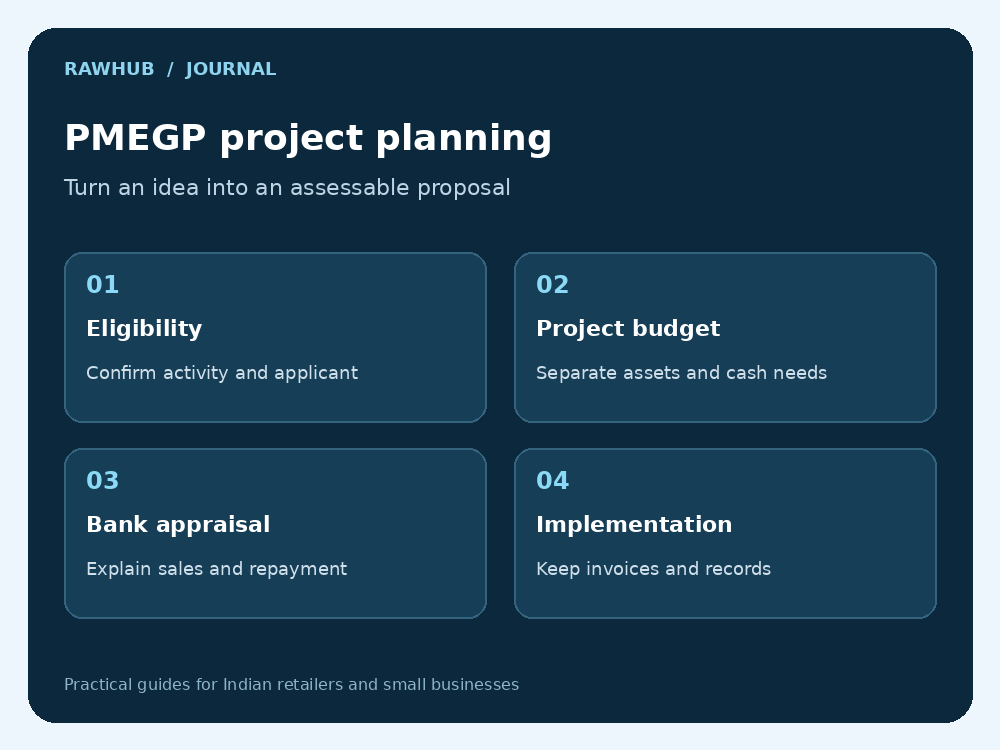
- Confirm applicant and activity eligibility.
- Calculate project cost and your own contribution.
- Explain customers, sales and monthly cash needs.
- Submit evidence for appraisal.
- Implement the sanctioned project and keep records.
Do not treat an expected subsidy as cash already available for spending.
Check PMEGP eligibility before spending on the project
The official PMEGP portal describes support for new viable non-farm microenterprises and sets conditions for the applicant and activity. It identifies a minimum age above eighteen and educational requirements for projects above specified cost levels. Projects without capital expenditure are not eligible under the stated new-unit rules. Existing units and prior government subsidy can affect eligibility. Read the relevant category carefully rather than relying on a general social-media summary.
Trading needs particular attention. The portal permits specified trading activities, including certain sales outlets in the North Eastern Region, subject to conditions and allocation limits. That is not blanket permission for every shop, marketplace or company. An Assam entrepreneur should describe the proposed activity precisely to the implementing agency and ask whether the applicant’s legal form and project qualify before paying deposits.
Separate the business idea from the scheme application
Write your business idea in everyday language. State who will buy, what they will receive, how frequently they may buy and why they would choose you. For a small processing unit, explain the raw material, conversion process and finished product. For a service activity, describe the equipment, staff skills and customer catchment. Avoid starting with a copied industry introduction that says little about your actual operation.
Next, list the assumptions that need proof. A location near a market may help, but it does not establish daily sales. A supplier’s statement that a machine is profitable is not customer evidence. Talk to prospective buyers, collect indicative purchase requirements and compare competing offers. Record what people actually said, including objections about price, quality or delivery. This research can change the project before borrowing makes changes expensive.
Build a project-cost sheet with evidence
Break the budget into equipment, installation, eligible premises-related costs, initial operating requirements and other permitted items. Use the scheme’s current rules to determine which costs can be included; land cost and other exclusions need particular care. Keep quotations current and specify whether taxes, delivery, installation and accessories are included. Two machines with similar names may have very different usable capacity and support arrangements.
For each line, record the supplier, quotation date, amount and purpose. Explain how it contributes to operations. A printer for invoices might be a small cost, but an unexplained expensive vehicle can dominate the budget and weaken the proposal. Separate essential items from upgrades that could wait until the business proves demand. A leaner project may be easier to manage and leave more flexibility after launch.
Understand contribution, borrowing and subsidy timing
Use three separate lines in your financial plan: the money you contribute, the borrowing arranged by the bank and the subsidy treatment applicable to the project. These are different sources with different conditions. Ask when each becomes available and how the bank will account for it. Do not subtract an expected subsidy from tomorrow’s equipment payment unless the bank has clearly explained that treatment in writing.
Subsidy-linked lending includes procedural conditions, verification and adjustment requirements. Treat the subsidy as conditional support, not unrestricted cash or an immediate reduction in every repayment. Obtain the current contribution percentage and margin-money conditions from the implementing agency for your category and location. A budget that works only if support arrives earlier than the rules allow is vulnerable even when the underlying business idea is reasonable.
Illustration: turn a cost list into a funding plan
Suppose an illustrative project needs ₹6 lakh for equipment and installation, ₹2 lakh for opening operating needs and ₹1 lakh for other permitted setup items. The total is ₹9 lakh before checking eligibility of each line. These figures are not a recommended project size or a scheme entitlement. They simply show why a total must be supported by a detailed schedule.
Now ask which costs must be paid before production begins, which suppliers accept staged payments and how much cash remains after installation. If all available money goes into machinery, the unit might be unable to buy raw material or pay wages. Discuss the timing with the bank and suppliers. A complete plan describes both the funding sources and the month in which each payment will occur.
Estimate sales from practical capacity
Start with how much the business can realistically produce or deliver during an ordinary month. Allow for downtime, training, rejected output, holidays and uneven customer demand. Multiply sellable units by a realistic net selling price. Then show what portion of those sales is collected immediately and what portion is on credit. Capacity is not the same as demand, and an invoice is not the same as collected money.
For example, a machine capable of making a large daily quantity does not create buyers for that quantity. Build an initial ramp-up period and explain how orders will be developed. A small confirmed customer base is stronger evidence than an unsupported claim that a tiny share of a national market will guarantee success. Keep the assumptions visible so the lender can understand and challenge them.
Calculate the cash needed after opening
Prepare a monthly forecast showing customer collections and every significant payment. Include materials, wages, utilities, rent, transport, repairs, taxes and loan obligations. Keep owner withdrawals visible as well. The first few months often involve building stock or receivables before cash becomes predictable. Identify the lowest projected bank balance, because that is where the project may need a smaller launch or additional genuine contribution.
Run a slower-sales case. Reduce the expected volume, delay collections and keep fixed costs unchanged initially. If the cash balance becomes negative, identify an operational response such as staged equipment purchases or a narrower product range. Do not solve the forecast by assuming another loan will certainly be approved. Rawhub’s cash conversion cycle guide can help connect stock purchases with eventual collections.
Prepare a concise, consistent application folder
Ask for the current official checklist and organise the required identity, educational, category, location and business records as applicable. Keep the project report, quotations and financial forecast consistent. The equipment total in the narrative should agree with the cost sheet. The sales forecast should agree with planned capacity. Explain any change instead of leaving conflicting versions in the application.
For every assumption, distinguish an actual fact from an estimate. Label a quotation as a quotation and a prospective customer discussion as a discussion, not a confirmed purchase order. Do not manufacture commitments, employment figures or sales history. An honest proposal gives the agency and bank a clearer basis for appraisal and leaves you with a plan you can actually use when the business starts.
Keep implementation records from day one
After sanction, follow the approved conditions and ask before making material changes to the project. Keep invoices, payment proofs, delivery records and evidence of installation together. Record equipment serial numbers and warranties where relevant. Maintain a simple register of spending against the sanctioned budget, noting any variation and the bank’s response. This protects you from confusing planned expenditure with completed expenditure.
Review operations weekly during the launch period. Compare actual output, sales, collections and costs with the proposal. If demand is weaker than expected, act early rather than buying more raw material to match the original forecast. Your project report should become a working management document. It is useful only if its assumptions are tested against real trading and updated as the business learns.
Questions worth asking before you apply
- Does this exact activity and applicant form qualify under the current rules?
- Which project costs are eligible, and which must be funded separately?
- What own contribution applies, and when must it be available?
- How will the subsidy be held, verified and adjusted?
- What training, registration and implementation conditions must be met?
- What repayments and charges apply if the business starts more slowly?
Frequently asked questions
Is PMEGP an automatic cash grant?
No. It involves a scheme-specific process and bank appraisal. Do not assume that submitting an application guarantees either a loan sanction or subsidy release.
Can a trading business in Assam apply?
The official portal provides for specified trading activities in the North Eastern Region, with conditions. Confirm your particular activity, applicant form and current allocation with the implementing agency.
Should I buy equipment before approval?
Do not assume expenditure made in advance will be accepted. Clarify the permissible sequence with the agency and bank before committing money that depends on scheme support.
Official sources and next steps
Consult the official PMEGP portal and the published scheme guidelines, together with any subsequent amendments. For a different borrowing route, read our MUDRA eligibility guide. Checked on 9 October 2026. Examples are educational and do not establish eligibility, approval or financial returns.