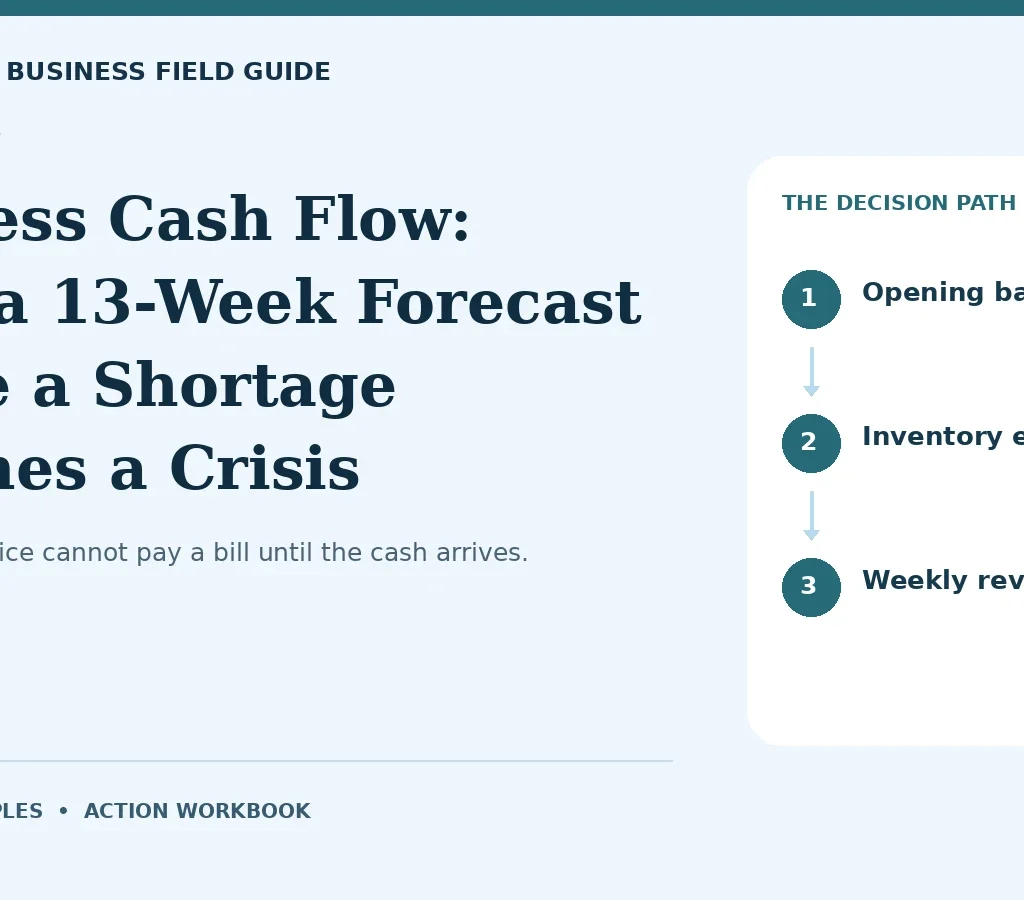
A profitable invoice cannot pay a bill until the cash arrives.
A business can report sales while struggling to meet payroll. The cause is often timing: customers pay later than suppliers, inventory absorbs money, or an annual bill arrives in a weak month. A cash forecast makes that timing visible. A thirteen-week horizon is a practical planning choice because it is short enough to update frequently and long enough to see many operating cycles. It is not an official requirement or a guarantee that every problem will appear. The important habit is to forecast receipts and payments by the week in which money actually moves.
Begin with usable opening cash
Start from reconciled bank balances and identify funds that are restricted or needed for specific obligations. Do not casually treat collected sales tax or payroll-related amounts as surplus operating money. Separate credit availability from cash already on hand. If you include a line of credit in a scenario, show the draw and repayment explicitly. The first week should tie to real account records. A forecast built on an inaccurate opening balance produces false confidence even when later calculations are correct. Assign one person to maintain the model and document the last update.
Forecast receipts by collection date
List expected customer receipts, not simply planned revenue. Use invoice due dates, customer history, deposits, and known delays. Mark uncertain receipts so they can be moved in a downside scenario. New sales should reflect your actual selling and payment cycle. If a customer usually pays forty days after invoicing, a thirty-day contractual term alone may overstate near-term cash. Keep customer concentration visible. A forecast depending on one large receipt deserves a specific follow-up plan rather than a general assumption that collections will improve.
Place payments on the calendar
Include payroll, supplier payments, rent, software, insurance, taxes, debt payments, inventory commitments, and planned owner withdrawals. Separate essential contractual obligations from discretionary purchases. Annual or quarterly bills should appear when due instead of being smoothed into an average. Record deposits and balances for large purchases. Avoid double-counting a credit-card purchase and its later card repayment. Choose a consistent approach and reconcile it. The goal is to understand bank movements; accounting expenses and cash payments do not always occur at the same time.
Look at the lowest balance
Calculate closing cash for each week and carry it forward. The weakest week may matter more than the final balance. A business that ends the quarter comfortably can still encounter a payroll shortfall halfway through. Define a management trigger before the balance reaches zero. That trigger might prompt collection calls, purchase delays, or a financing discussion. It should reflect the business’s obligations and tolerance for uncertainty. A forecast should produce decisions, not just a colorful chart. Write the actions beside the weeks where they are needed.
Model responses without inventing cash
Moving a purchase can help if the supplier agrees and service delivery remains viable. Faster invoicing can help when the work is complete and terms support it. Deposits can help when customers accept them and the agreement is clear. None of these changes should be inserted as certain cash until there is a basis. Distinguish proposed actions from confirmed actions. If financing is being discussed, do not record it as available before approval and disbursement conditions are met. A conservative model is useful because it exposes the work still required.
Update forecast against actual results
At the end of each week, replace estimates with actual receipts and payments, explain major differences, and add another week. Persistent collection delays should change future assumptions. Unexpected supplier bills may reveal weak purchase controls. The SBA’s business-management resources emphasize financial understanding and bookkeeping; the forecast is your original management tool for turning those records into near-term decisions. Share a short summary with responsible managers: lowest projected cash, overdue receipts, committed purchases, and actions awaiting confirmation. Keep sensitive customer and banking information protected. Official reference: SBA: Manage your business.
A worked example
Illustrative example: a service company starts a week with $18,000, expects $9,000 in customer receipts, and has $16,000 in scheduled payments. Closing cash would be $11,000. A $7,000 receipt then moves two weeks later. Without other changes, this week closes at $4,000. The owner sees the gap before it becomes an emergency, confirms the customer’s payment timing, and postpones a discretionary purchase with the vendor’s agreement. The business does not alter payroll or tax obligations casually. These fictional figures illustrate a timing shock; they are not a recommended cash threshold for every company.
Try your own numbers
Change the example inputs to explore this simple planning relationship.
Closing cash ($)Illustrative arithmetic only. This tool does not estimate taxes, loan eligibility, legal requirements, insurance coverage, or net profit. It uses no external service and does not store your inputs.
The worked example and formula above remain available without JavaScript.
Your action workbook
Use the following checkpoints as a working document, not a score that promises success. Each one connects a specific action to evidence and a warning sign. Review the items in sequence or start with the weakest area in your business. The checkboxes are a temporary reading aid; they do not save personal information or certify compliance. Keep any actual records securely in your own operating system. For questions involving legal, tax, lending, insurance, or employment obligations, obtain appropriate current guidance. Your final decision should reflect the evidence, the cost of being wrong, and the capacity to maintain the process after the initial setup.
01 Opening balance
Establish the starting point. Reconcile the cash balance and separate restricted or committed amounts. Keep this in a dated decision record. Assign any unresolved question to a responsible person before committing money or making a customer promise.
Evidence to keep: Bank records matching the forecast’s starting point.
Warning sign: Counting every account balance as freely spendable money.
02 Receivable schedule
Test before committing. Place customer receipts in the weeks they are realistically collectible. Use a representative situation, record the result, and revise weak assumptions before expansion. A small test should inform the next decision, including when to pause.
Evidence to keep: Invoice aging and customer payment history.
Warning sign: Assuming invoiced sales arrive immediately.
03 Sales assumptions
Make the evidence retrievable. Translate expected new orders into receipt timing. Store the supporting record with its date and limitations. Compare new findings with the original assumption so changes remain visible to the next reviewer.
Evidence to keep: A sales pipeline linked to payment terms.
Warning sign: Forecasting deposits that customers have not agreed to pay.
04 Payment calendar
Check the real-world constraint. Record payroll, vendors, rent, taxes, debt, and large commitments. Confirm the practical effect with the responsible operator or qualified adviser. Record whether it changes scope, timing, cost, or the ability to proceed.
Evidence to keep: Due dates and supporting statements.
Warning sign: Averaging annual bills across months when cash leaves at once.
05 Inventory exposure
Separate confirmation from expectation. Show purchase deposits and balances before expected sales. Label unverified assumptions clearly. Obtain stronger evidence when the decision depends heavily on them, and avoid passing an expectation to others as a guarantee.
Evidence to keep: Purchase orders and delivery schedules.
Warning sign: Ignoring stock purchases because inventory is an asset.
06 Lowest cash point
Assign a usable next action. Identify the weakest projected week and an action trigger. Name one responsible person and define completion. Record dependencies on other parties, then follow up through an appropriate verified channel rather than an informal assumption.
Evidence to keep: A balance chart with the critical week labeled.
Warning sign: Looking only at the final quarter balance.
07 Collection action
Compare the alternatives fairly. Assign follow-up on overdue or uncertain receipts. Use equivalent scope and timing. Record the tradeoff affecting your operation instead of selecting from a favorable headline whose underlying conditions may differ.
Evidence to keep: Named contacts and documented promised dates.
Warning sign: Using optimistic collection dates without customer confirmation.
08 Spending response
Plan for the ordinary exception. Separate essential obligations from purchases that can be delayed. Consider delays, missing records, or weaker results. Decide who notices and what happens next so the process does not depend on an unwritten workaround.
Evidence to keep: Written vendor agreements for changed timing.
Warning sign: Moving a payment in the model without changing the real obligation.
09 Downside scenario
Turn review into a decision. Delay the largest receipts and assess the resulting cash gap. Choose whether to continue, revise, or pause using the findings. Record the reason and the next review trigger rather than adding activity without resolving the constraint.
Evidence to keep: A second scenario with explicit changed assumptions.
Warning sign: Treating unapproved borrowing as guaranteed cash.
10 Weekly review
Maintain the improvement. Replace forecasts with actuals and explain material differences. Review this after material changes. Keep ownership and current instructions clear, because a completed setup can become outdated as people, conditions, and the business evolve.
Evidence to keep: A rolling variance log and next actions.
Warning sign: Maintaining an impressive forecast that nobody updates.
Make the next decision
The strongest cash review ends with a small list of confirmed actions. For each weak week, identify which receipt needs follow-up, which purchase needs a decision, and which obligation cannot be moved casually. Assign a person and a date. Keep proposed remedies visibly separate from agreed remedies. This prevents the spreadsheet from becoming more optimistic than the real business. Review the relationship between cash and operating performance as well. If a shortage repeats even after collections improve, the problem may include pricing, costs, or insufficient demand. A forecast shows timing but does not automatically diagnose the whole model. Use it with contribution analysis and reliable books. When the team understands the weakest week and the actions attached to it, the forecast becomes a practical coordination tool instead of a report that only the owner sees.
Frequently asked questions
Does cash flow mean profit?
No. Profit and cash measure different things. Customer payment timing, inventory purchases, debt principal, and capital spending can create differences. Review both operating profitability and available cash.
Why thirteen weeks?
It is a useful management horizon, not a universal rule. You can shorten or extend it based on your operating cycle. Updating the forecast and acting on the weakest period matters more than selecting a fashionable number of weeks.
Continue with a related guide
Official sources and scope
Sources checked October 12, 2026. Official links support the regulatory and program checkpoints; the business examples, planning methods, and workbook are original editorial material. Rules, terms, and opportunities can change. This is general educational content; use current professional guidance for decisions specific to your business.