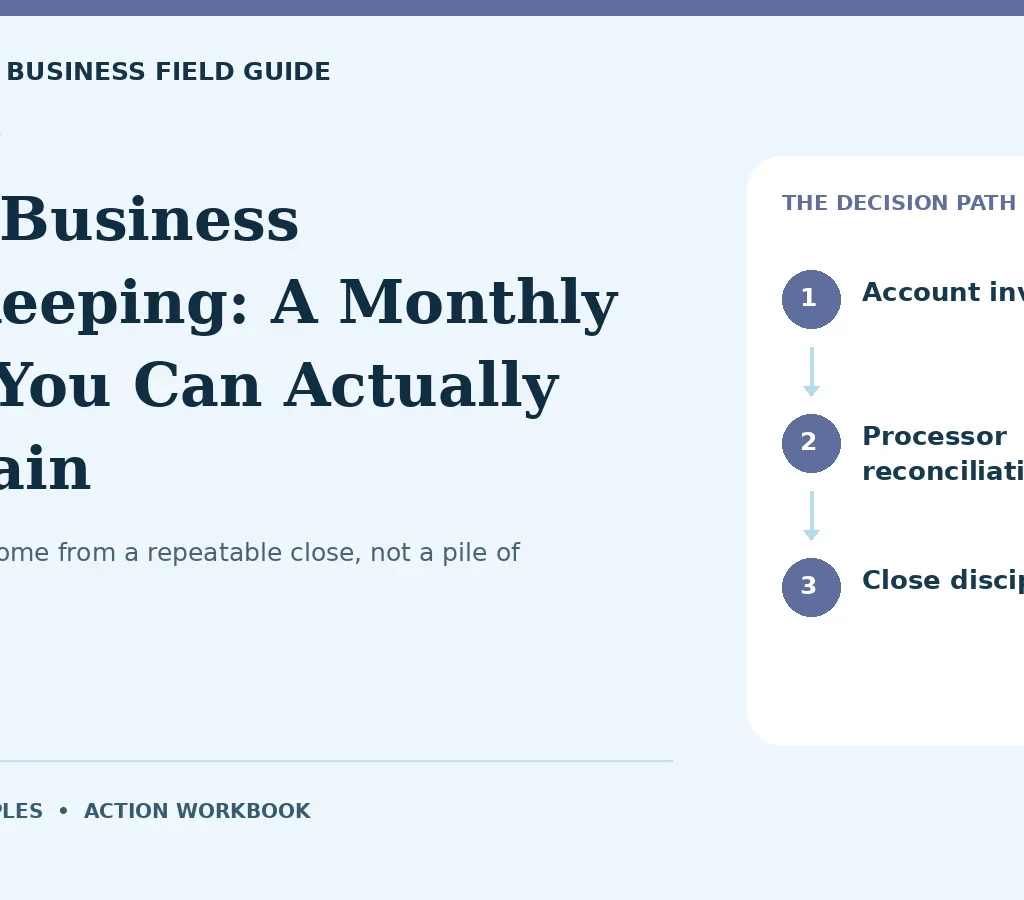
Reliable books come from a repeatable close, not a pile of receipts.
Bookkeeping becomes stressful when it is treated as an annual rescue operation. Transactions accumulate, documents disappear, and the owner cannot explain the bank balance. A monthly close turns bookkeeping into a smaller recurring task. The aim is not to become an accountant overnight. It is to create records that can be reconciled, understood, and reviewed with a qualified professional when needed. This guide covers an operating routine for US small businesses. Tax treatment, filing obligations, and record-retention requirements should be checked for your circumstances rather than inferred from a generic checklist.
Define the boundaries of the books
Identify every business bank account, credit card, payment processor, loan, and cash channel. Keep business activity traceable and address personal transactions explicitly rather than quietly categorizing them as business expenses. Decide who records transactions and who reviews them. Use a chart of accounts that reflects how you need to understand the operation without creating dozens of nearly identical categories. A practical system makes recurring decisions consistent. It should not require the owner to reinvent the categorization of the same software subscription every month.
Collect evidence at the transaction
Store invoices, receipts, contracts, and payment records when activity occurs. Include enough context to understand the business purpose and identify the vendor or customer. The IRS recordkeeping guidance says records should show income and expenses and support reported items. Your collection process can use a shared folder, accounting attachment feature, or another secure system appropriate to the business. The tool matters less than whether documents are complete and retrievable. Set a naming convention and limit access to sensitive records. Do not assume a bank description proves every detail of a transaction. Official reference: IRS: Recordkeeping.
Reconcile money movement
Compare book balances with bank and card statements. Review outstanding checks, deposits, transfers, processor settlements, and fees. A payment processor may deposit revenue net of charges, so recording only the deposit can obscure gross sales and fees. Ensure transfers between business accounts are not accidentally treated as revenue. Investigate duplicates and unexplained differences rather than forcing the balance to agree with an unsupported adjustment. Reconciliation is a control process. It verifies that the transaction record connects to actual money movement and highlights gaps requiring investigation.
Review customers and suppliers
Examine unpaid customer invoices and outstanding vendor bills. Confirm whether receivables are collectible and whether credits or disputes need attention. Check supplier statements where relevant. A business can appear profitable because invoices remain unpaid or expenses have not been entered. Review inventory and job costs if they matter to your model. Ask your accountant how the appropriate accounting method and adjustments affect reporting. Keep collection action separate from accounting entries: changing a report does not cause a customer to pay.
Produce reports with a purpose
Review the profit-and-loss statement, balance sheet, and cash information appropriate to the business. Compare current results with prior periods and your operating plan. Explain the largest differences in plain language. A sudden increase in gross margin may signal a real improvement or a missing cost. A growing sales number may coexist with worsening cash collections. Reports are useful when they lead to questions and decisions. Keep a short close memo covering unusual items, unresolved issues, and the owner’s next actions.
Set a close deadline and escalation path
Choose a workable schedule for collecting records, reconciling accounts, reviewing adjustments, and approving reports. If a document is missing, record who will obtain it and when. Lock or control changes to completed periods using the features appropriate to your system. Ask a qualified professional about accounting and tax questions before filing decisions become urgent. The goal is a dependable routine that can continue during busy months. A simple close completed consistently is more valuable than an elaborate checklist abandoned after the first attempt.
A worked example
Illustrative example: a business records a $4,850 processor deposit as revenue. The settlement detail shows $5,000 of customer payments and $150 in fees. Recording the components helps the owner understand sales and processing cost correctly. During reconciliation, a duplicated $220 software charge is found and corrected with supporting evidence. The close memo also identifies $3,000 in overdue invoices requiring collection follow-up. These examples are fictional and illustrate process. The appropriate accounting entries and tax treatment depend on the business’s method and should be confirmed with its professional adviser.
Try your own numbers
Change the example inputs to explore this simple planning relationship.
Unreconciled difference ($)Illustrative arithmetic only. This tool does not estimate taxes, loan eligibility, legal requirements, insurance coverage, or net profit. It uses no external service and does not store your inputs.
The worked example and formula above remain available without JavaScript.
Your action workbook
Use the following checkpoints as a working document, not a score that promises success. Each one connects a specific action to evidence and a warning sign. Review the items in sequence or start with the weakest area in your business. The checkboxes are a temporary reading aid; they do not save personal information or certify compliance. Keep any actual records securely in your own operating system. For questions involving legal, tax, lending, insurance, or employment obligations, obtain appropriate current guidance. Your final decision should reflect the evidence, the cost of being wrong, and the capacity to maintain the process after the initial setup.
01 Account inventory
Establish the starting point. Identify all business banks, cards, processors, loans, and cash channels. Keep this in a dated decision record. Assign any unresolved question to a responsible person before committing money or making a customer promise.
Evidence to keep: A complete list with responsible record owners.
Warning sign: Closing the books while omitting one active payment channel.
02 Document capture
Test before committing. Collect supporting records at the time of purchase or sale. Use a representative situation, record the result, and revise weak assumptions before expansion. A small test should inform the next decision, including when to pause.
Evidence to keep: Retrievable invoices and receipts linked to transactions.
Warning sign: Treating a bank memo as complete evidence for every expense.
03 Category consistency
Make the evidence retrievable. Use clear account categories and document recurring treatment. Store the supporting record with its date and limitations. Compare new findings with the original assumption so changes remain visible to the next reviewer.
Evidence to keep: A short coding guide approved by the reviewer.
Warning sign: Creating a new category for every unfamiliar vendor.
04 Bank reconciliation
Check the real-world constraint. Match records to statements and investigate unexplained differences. Confirm the practical effect with the responsible operator or qualified adviser. Record whether it changes scope, timing, cost, or the ability to proceed.
Evidence to keep: Reconciliation reports with supported outstanding items.
Warning sign: Using an arbitrary adjustment to force agreement.
05 Processor reconciliation
Separate confirmation from expectation. Separate settlements, gross collections, fees, refunds, and reserves where relevant. Label unverified assumptions clearly. Obtain stronger evidence when the decision depends heavily on them, and avoid passing an expectation to others as a guarantee.
Evidence to keep: Settlement reports linked to bank deposits.
Warning sign: Recording every net deposit as the entire sales figure.
06 Receivable review
Assign a usable next action. Review overdue customer balances and disputes. Name one responsible person and define completion. Record dependencies on other parties, then follow up through an appropriate verified channel rather than an informal assumption.
Evidence to keep: An aging report with collection actions.
Warning sign: Assuming every open invoice will be paid on schedule.
07 Payable review
Compare the alternatives fairly. Check vendor bills, statements, credits, and upcoming obligations. Use equivalent scope and timing. Record the tradeoff affecting your operation instead of selecting from a favorable headline whose underlying conditions may differ.
Evidence to keep: A payable schedule matching available evidence.
Warning sign: Leaving expenses out because the invoice arrived late.
08 Reporting review
Plan for the ordinary exception. Read profit, balance-sheet, and cash information together. Consider delays, missing records, or weaker results. Decide who notices and what happens next so the process does not depend on an unwritten workaround.
Evidence to keep: Explanations of the largest changes and unusual items.
Warning sign: Celebrating profit without reviewing collection timing.
09 Professional questions
Turn review into a decision. Send accounting and tax uncertainties with supporting documents. Choose whether to continue, revise, or pause using the findings. Record the reason and the next review trigger rather than adding activity without resolving the constraint.
Evidence to keep: A question log and documented adviser responses.
Warning sign: Guessing tax treatment from a software category name.
10 Close discipline
Maintain the improvement. Set a deadline, approve reports, and control subsequent changes. Review this after material changes. Keep ownership and current instructions clear, because a completed setup can become outdated as people, conditions, and the business evolve.
Evidence to keep: A completed close checklist with unresolved items assigned.
Warning sign: Reopening past periods without documenting the reason.
Make the next decision
Make the close memo short enough that the owner will read it. Include the largest unexplained difference, overdue customer balances requiring action, upcoming commitments, and accounting questions awaiting advice. Link each issue to a responsible person. A clean-looking report with unresolved evidence is less useful than a transparent report that identifies what remains uncertain. Keep corrections traceable so the next reviewer can understand what changed. If the same issue recurs each month, improve the upstream process. Missing receipts may require better capture; processor confusion may require a settlement routine; repeated duplicates may require integration changes. Bookkeeping quality comes from those operating habits as much as from end-of-month effort. A maintained close gives the business a foundation for pricing, borrowing, tax preparation, and cash decisions without requiring every discussion to begin with a search for documents.
Frequently asked questions
Do I need expensive software?
Not automatically. Choose a system that supports the records, reconciliations, and reporting you need. Complexity, transaction volume, inventory, payroll, and professional support affect the decision.
How long should I keep documents?
Retention depends on the record and circumstances. The IRS recordkeeping page explains that retention relates to the action, expense, or event documented. Confirm applicable requirements instead of assuming one period fits everything.
Continue with a related guide
Official sources and scope
Sources checked October 12, 2026. Official links support the regulatory and program checkpoints; the business examples, planning methods, and workbook are original editorial material. Rules, terms, and opportunities can change. This is general educational content; use current professional guidance for decisions specific to your business.