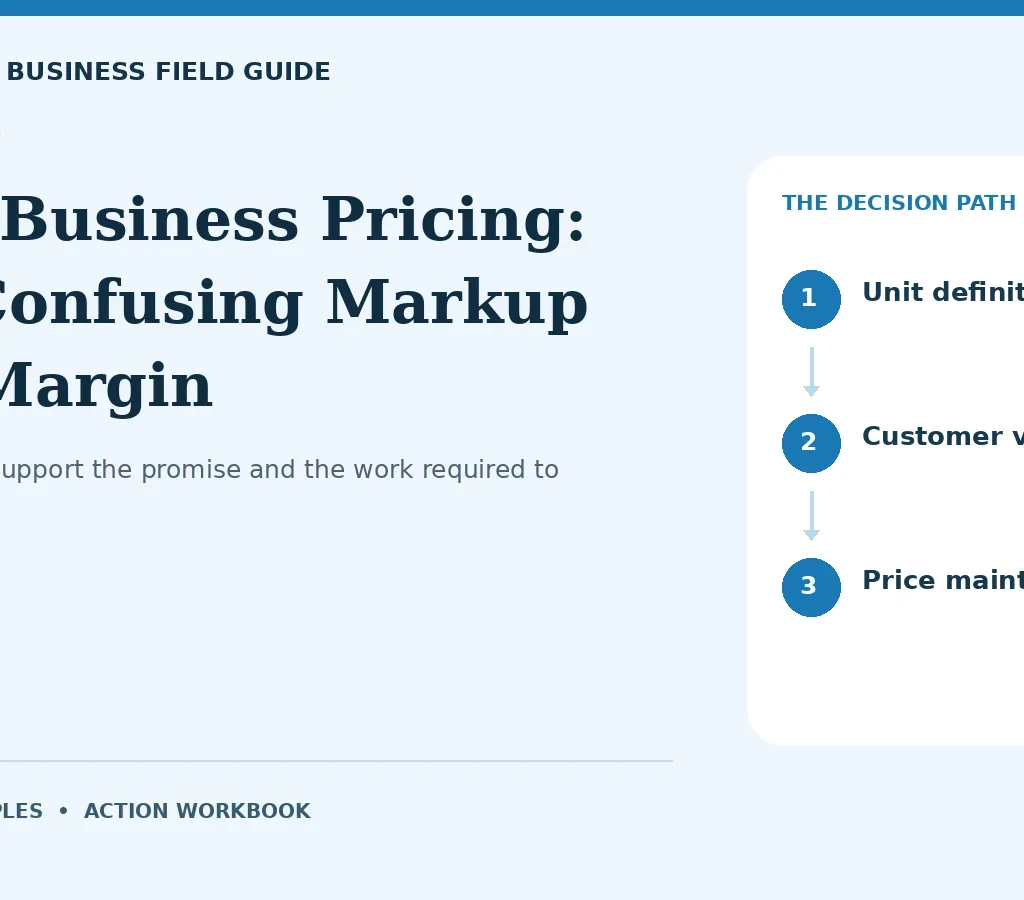
The price must support the promise and the work required to deliver it.
A price can attract customers and still weaken the business. The common cause is a cost model that omits labor, returns, support, transaction fees, or overhead. Another is confusing markup with margin. A useful pricing process connects the customer’s value, your delivery cost, market alternatives, and the capacity you can sell. This guide helps US small businesses build that process using transparent examples. It does not supply a universal profit target or recommend that every company charge the highest price possible. The right price must work for the offer and the buyer.
Define the unit you are pricing
A unit could be one product, appointment, project, subscription month, or bundled service. Describe what is included, excluded, and allowed before calculating costs. A fixed project price becomes risky when revisions or travel are unlimited. A subscription becomes expensive to deliver when every customer receives unlimited individual support. Create a scope that customers can understand and staff can execute. Pricing begins with the promise. If the promise is vague, a precise spreadsheet may still understate the real amount of work required.
Separate variable cost from overhead
Identify costs that increase when you deliver one more unit: materials, direct delivery labor, packaging, transaction fees, and relevant shipping or support. Then identify fixed or capacity-related overhead. Some costs are mixed, so state your assumptions. Contribution per unit is price minus variable cost; it helps cover overhead and other business needs. Do not call contribution net profit. The distinction matters when deciding whether an additional order is worthwhile and whether the business as a whole is sustainable. Review actual completed jobs to check the estimates.
Calculate markup and margin correctly
Markup compares the added amount with cost. Gross margin compares gross profit with selling price. If an item costs $60 and sells for $100, markup is about 66.7%, while gross margin is 40%. Those percentages describe the same transaction from different bases. Decide what the cost figure includes before using either measure. Accounting gross margin and a management contribution calculation may use different classifications. Label the metric clearly. A pricing policy based on a misunderstood percentage can systematically undercharge every item even when each calculation appears consistent.
Consider value and alternatives
Costs establish part of the economic floor, but customers also compare outcomes, convenience, risk, trust, and alternatives. Interview buyers and review actual lost-sale reasons. Avoid assuming the cheapest competitor sets your only possible price. A better service promise may justify a different offer, but only if customers understand and value it. Present options with clear scope differences rather than arbitrary labels. Do not fabricate discounts or urgency. A price test should preserve truthful communication and give you evidence about demand at a specific offer.
Test discounts through contribution
A discount reduces price while many delivery costs remain unchanged. Calculate the new contribution and the extra units needed to produce the previous total contribution. Consider whether the business has enough demand and capacity to sell those units. Promotions can be useful for a defined purpose, but repeating discounts can teach customers to wait or attract orders that do not support the operation. Record the reason, duration, and success measure. A campaign producing more sales but less total contribution may not be an improvement.
Review prices with operating evidence
Track completed-order costs, rework, cancellations, returns, and customer response. Update assumptions when supplier costs or scope change. Communicate price changes clearly and respect existing agreements. Use break-even calculations alongside cash planning and capacity limits. A business can reach a unit break-even target while still struggling with payment timing. The useful review asks whether the offer is profitable to deliver, attractive to the intended buyer, and manageable for the team. Treat pricing as a maintained decision rather than a number chosen once at launch. Official reference: SBA: Break-even calculation.
A worked example
Illustrative example: a service sells for $200 with $120 variable cost, leaving $80 contribution. A 10% discount lowers price to $180 and contribution to $60. To generate the same $800 contribution previously earned from ten jobs, the business needs about 13.33 jobs, meaning fourteen whole jobs if all are identical. That is a 40% increase in whole-job volume for the comparison. The owner checks whether demand and capacity support it. These fictional numbers show the mechanics; they are not a recommended discount or industry margin.
Try your own numbers
Change the example inputs to explore this simple planning relationship.
Contribution per sale ($)Illustrative arithmetic only. This tool does not estimate taxes, loan eligibility, legal requirements, insurance coverage, or net profit. It uses no external service and does not store your inputs.
The worked example and formula above remain available without JavaScript.
Your action workbook
Use the following checkpoints as a working document, not a score that promises success. Each one connects a specific action to evidence and a warning sign. Review the items in sequence or start with the weakest area in your business. The checkboxes are a temporary reading aid; they do not save personal information or certify compliance. Keep any actual records securely in your own operating system. For questions involving legal, tax, lending, insurance, or employment obligations, obtain appropriate current guidance. Your final decision should reflect the evidence, the cost of being wrong, and the capacity to maintain the process after the initial setup.
01 Unit definition
Establish the starting point. Write the exact product, project, appointment, or period being priced. Keep this in a dated decision record. Assign any unresolved question to a responsible person before committing money or making a customer promise.
Evidence to keep: A scope customers and staff can interpret consistently.
Warning sign: Pricing a promise with unlimited unmeasured work.
02 Variable cost
Test before committing. Record materials, delivery labor, fees, and transaction-related support. Use a representative situation, record the result, and revise weak assumptions before expansion. A small test should inform the next decision, including when to pause.
Evidence to keep: Cost sheets from completed representative orders.
Warning sign: Ignoring small fees that occur on every sale.
03 Overhead map
Make the evidence retrievable. Identify fixed commitments and capacity-related costs separately. Store the supporting record with its date and limitations. Compare new findings with the original assumption so changes remain visible to the next reviewer.
Evidence to keep: A monthly operating-cost schedule.
Warning sign: Calling contribution the same thing as net profit.
04 Metric definition
Check the real-world constraint. Label markup, gross margin, and contribution using their correct bases. Confirm the practical effect with the responsible operator or qualified adviser. Record whether it changes scope, timing, cost, or the ability to proceed.
Evidence to keep: A worked example checked against the formula.
Warning sign: Applying a margin target as though it were a markup.
05 Customer value
Separate confirmation from expectation. Ask what outcome, convenience, or risk reduction buyers value. Label unverified assumptions clearly. Obtain stronger evidence when the decision depends heavily on them, and avoid passing an expectation to others as a guarantee.
Evidence to keep: Purchase and lost-sale explanations.
Warning sign: Assuming a higher price is justified because you prefer it.
06 Competitive alternatives
Assign a usable next action. Compare the options the customer actually considers. Name one responsible person and define completion. Record dependencies on other parties, then follow up through an appropriate verified channel rather than an informal assumption.
Evidence to keep: A dated comparison of scope and customer experience.
Warning sign: Matching a competitor’s price without matching the offer.
07 Offer packages
Compare the alternatives fairly. Create options with meaningful differences in scope or service. Use equivalent scope and timing. Record the tradeoff affecting your operation instead of selecting from a favorable headline whose underlying conditions may differ.
Evidence to keep: A clear customer-facing comparison.
Warning sign: Using premium labels with no understandable added value.
08 Discount test
Plan for the ordinary exception. Recalculate contribution and required volume before promoting. Consider delays, missing records, or weaker results. Decide who notices and what happens next so the process does not depend on an unwritten workaround.
Evidence to keep: A promotion model including capacity limits.
Warning sign: Judging a discount only by increased revenue.
09 Actual-cost review
Turn review into a decision. Compare estimates with labor, rework, returns, and support. Choose whether to continue, revise, or pause using the findings. Record the reason and the next review trigger rather than adding activity without resolving the constraint.
Evidence to keep: A variance log for representative completed orders.
Warning sign: Keeping launch costs unchanged after delivery proves different.
10 Price maintenance
Maintain the improvement. Review triggers and communicate changes clearly. Review this after material changes. Keep ownership and current instructions clear, because a completed setup can become outdated as people, conditions, and the business evolve.
Evidence to keep: A pricing calendar and records of existing commitments.
Warning sign: Changing prices without understanding contract or customer expectations.
Make the next decision
Keep a pricing decision record for the offer most important to the business. Include the defined unit, current cost evidence, contribution, overhead context, customer alternatives, and the reason for the selected price. If you discount, record the objective and the required volume before launch. Review whether the campaign attracted suitable customers and whether repeat purchases occur without constant reductions. If a price increase is needed, explain the change clearly and consider existing agreements. Avoid changing several scope and price elements at once unless the purpose requires it, because the result becomes difficult to interpret. Pricing improves through delivery evidence and customer understanding. The useful outcome is an offer that customers can evaluate and the business can fulfill sustainably, rather than a percentage chosen because it appears common in another industry.
Frequently asked questions
Is a 50% markup a 50% margin?
No. Markup uses cost as the denominator, while margin uses selling price. With a $100 cost and a $150 price, markup is 50% and gross margin is about 33.3%.
Should I always match the lowest competitor?
No. Compare scope, quality, convenience, trust, and delivery economics. A lower price that cannot support the offer is not a sustainable strategy.
Continue with a related guide
Official sources and scope
Sources checked October 12, 2026. Official links support the regulatory and program checkpoints; the business examples, planning methods, and workbook are original editorial material. Rules, terms, and opportunities can change. This is general educational content; use current professional guidance for decisions specific to your business.