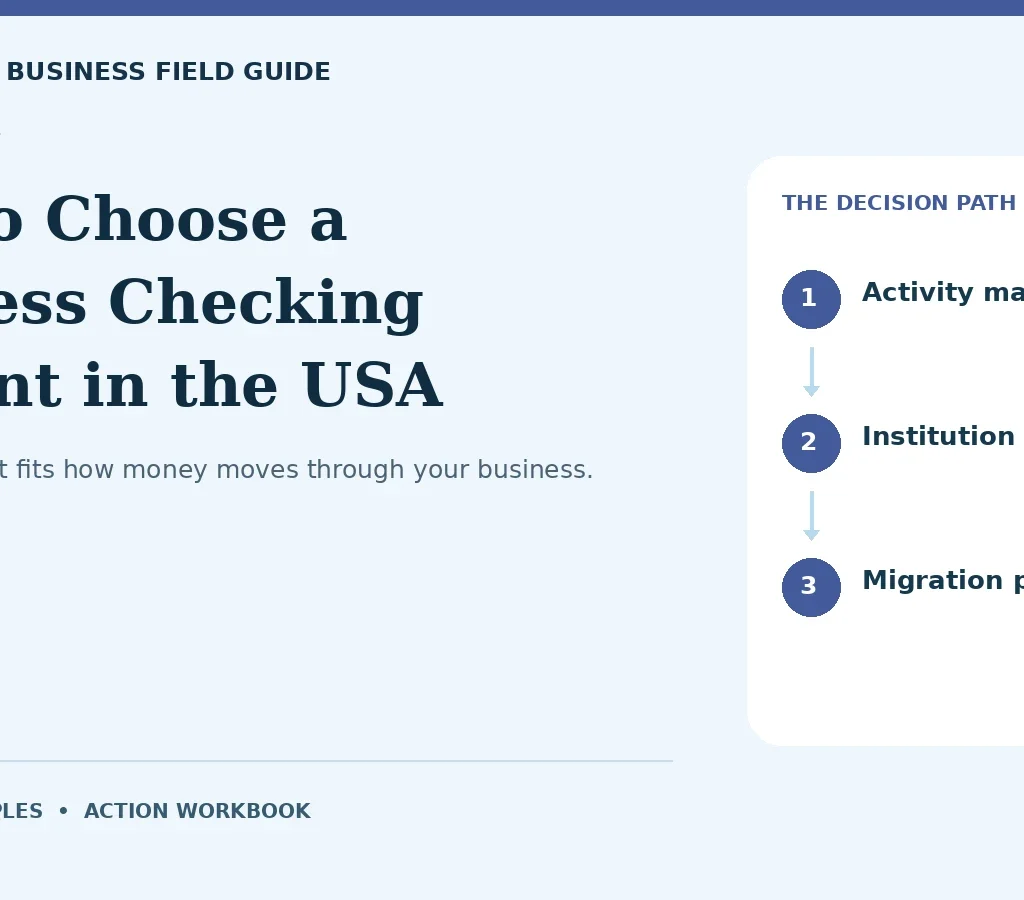
The best account fits how money moves through your business.
A business checking account can look inexpensive until you exceed a transaction allowance, deposit cash frequently, or need a payment feature the account does not support. Instead of starting with a promotional bonus, start with a typical month of activity. How often do customers pay? Do you handle cash? Who approves transfers? How quickly must funds become available? A US business owner should compare operational fit, total costs, controls, and the legal institution holding the funds. This guide offers a selection process without ranking providers or quoting temporary offers.
Map your payment behavior
List incoming card settlements, checks, ACH payments, wires, and cash deposits. List outgoing payroll, vendor payments, tax payments, transfers, and debt obligations. Record approximate volumes and the need for branch or ATM access. A remote consultant and a cash-heavy retailer have different requirements. Consider the practical effect of cutoffs, holds, and weekend timing. Ask the institution to explain availability rules for the payment methods you actually use. A feature described as instant may apply only to certain transactions or require additional fees.
Calculate total account costs
Look beyond the monthly maintenance fee. Compare minimum-balance conditions, transaction charges, cash-deposit allowances, wire fees, overdraft policies, and charges for added services. Promotional bonuses may include requirements or expiration dates. Use a sample month to calculate costs under each provider’s current fee schedule. Then test a busier and a quieter month. An account that is free only at a balance you cannot maintain is not effectively free for your business. Keep fee assumptions dated and verify them directly before applying.
Understand who holds the funds
A bank, a credit union, and a financial technology platform are not interchangeable descriptions. If you use a nonbank platform, identify the underlying institution and how the arrangement works. Verify deposit-insurance information with the institution and the relevant official agency; do not assume every balance displayed in an app receives identical protection. Ownership categories, account titling, and program structure can matter. The point is to ask precise questions before depositing operating funds, not to treat an app’s marketing badge as a complete explanation of the account. Official reference: IRS: Starting a business, FDIC: Understanding deposit insurance, FDIC: Understanding deposit insurance, FDIC: Understanding deposit insurance.
Evaluate controls for growing teams
A founder may initially handle all payments, but the account should support the controls you need as the team grows. Ask about separate user access, permissions, transfer limits, alerts, and approval workflows. Avoid sharing one login among multiple people. Determine how access is removed when someone leaves. Test whether bookkeeping integrations expose only the permissions required. Operational convenience is useful, but an account that makes unauthorized payments easy creates an expensive problem. Document who can initiate, approve, and reconcile transactions.
Prepare identity and business documents
Ask the provider which documents are required for your legal structure and ownership. Use consistent business names, addresses, and identification details. Requirements can differ by provider and applicant circumstances. Do not assume an EIN alone completes the process or proves a business is properly registered for all purposes. The IRS starting-business resources explain tax-related identity topics; the account provider handles its own opening requirements. Keep copies securely and avoid submitting sensitive information through an unverified link sent by an unsolicited message.
Migrate with a controlled overlap
Opening a new account is easier than moving every connected payment correctly. Inventory recurring charges, payroll instructions, customer payment details, and tax-payment arrangements. Verify vendor bank-change requests independently. Test the new account with limited activity, reconcile it, and update counterparties through trusted channels. Keep enough overlap to catch missed payments rather than closing the old account immediately. Decide when migration is complete using a checklist. A small fee saving is not worthwhile if the move causes missed payroll, duplicate payments, or collection delays.
A worked example
Illustrative example: a retailer compares an account with a $15 monthly fee waived at a specified balance and an account with no monthly maintenance fee but cash-deposit charges. In its sample month, cash charges total $28 on the second account. The first may be cheaper if the balance condition is reliably met, but the retailer also considers branch access and controls. A consultant with no cash deposits could reach a different conclusion. These are hypothetical schedules, not offers from real institutions. The correct decision depends on current terms and the business’s activity.
Try your own numbers
Change the example inputs to explore this simple planning relationship.
Monthly account cost ($)Illustrative arithmetic only. This tool does not estimate taxes, loan eligibility, legal requirements, insurance coverage, or net profit. It uses no external service and does not store your inputs.
The worked example and formula above remain available without JavaScript.
Your action workbook
Use the following checkpoints as a working document, not a score that promises success. Each one connects a specific action to evidence and a warning sign. Review the items in sequence or start with the weakest area in your business. The checkboxes are a temporary reading aid; they do not save personal information or certify compliance. Keep any actual records securely in your own operating system. For questions involving legal, tax, lending, insurance, or employment obligations, obtain appropriate current guidance. Your final decision should reflect the evidence, the cost of being wrong, and the capacity to maintain the process after the initial setup.
01 Activity map
Establish the starting point. List incoming and outgoing payment methods and monthly volumes. Keep this in a dated decision record. Assign any unresolved question to a responsible person before committing money or making a customer promise.
Evidence to keep: A recent transaction sample or realistic launch estimate.
Warning sign: Choosing from a headline fee without examining actual use.
02 Fee model
Test before committing. Calculate maintenance, transaction, cash, wire, and added-service charges. Use a representative situation, record the result, and revise weak assumptions before expansion. A small test should inform the next decision, including when to pause.
Evidence to keep: Current fee schedules tested against three activity levels.
Warning sign: Calling an account free while ignoring usage charges.
03 Balance condition
Make the evidence retrievable. Check whether fee waivers require a maintainable balance. Store the supporting record with its date and limitations. Compare new findings with the original assumption so changes remain visible to the next reviewer.
Evidence to keep: A cash forecast showing expected daily or monthly balances.
Warning sign: Keeping needed operating cash idle solely to earn a bonus.
04 Access requirements
Check the real-world constraint. Compare branch, ATM, mobile deposit, and payment availability. Confirm the practical effect with the responsible operator or qualified adviser. Record whether it changes scope, timing, cost, or the ability to proceed.
Evidence to keep: Provider explanations of limits and cutoffs.
Warning sign: Assuming every advertised feature applies to every payment.
05 Institution identity
Separate confirmation from expectation. Identify the legal institution and any intermediary arrangement. Label unverified assumptions clearly. Obtain stronger evidence when the decision depends heavily on them, and avoid passing an expectation to others as a guarantee.
Evidence to keep: Verified provider and official deposit-protection information.
Warning sign: Assuming a nonbank app is itself an insured bank.
06 User permissions
Assign a usable next action. Separate initiation, approval, and reconciliation access where appropriate. Name one responsible person and define completion. Record dependencies on other parties, then follow up through an appropriate verified channel rather than an informal assumption.
Evidence to keep: A role matrix and tested permissions.
Warning sign: Sharing one banking login across the team.
07 Security alerts
Compare the alternatives fairly. Configure notifications and independent verification for sensitive changes. Use equivalent scope and timing. Record the tradeoff affecting your operation instead of selecting from a favorable headline whose underlying conditions may differ.
Evidence to keep: A documented response to unexpected payments.
Warning sign: Relying only on a password to protect operating funds.
08 Document readiness
Plan for the ordinary exception. Collect the provider’s required identity and business records. Consider delays, missing records, or weaker results. Decide who notices and what happens next so the process does not depend on an unwritten workaround.
Evidence to keep: A current opening checklist for your structure.
Warning sign: Sending sensitive files through an unverified message link.
09 Integration test
Turn review into a decision. Check bookkeeping exports and connection permissions with sample transactions. Choose whether to continue, revise, or pause using the findings. Record the reason and the next review trigger rather than adding activity without resolving the constraint.
Evidence to keep: A successful reconciliation without duplicate entries.
Warning sign: Selecting an account only because it advertises integrations.
10 Migration plan
Maintain the improvement. Inventory connected payments and move them through a controlled checklist. Review this after material changes. Keep ownership and current instructions clear, because a completed setup can become outdated as people, conditions, and the business evolve.
Evidence to keep: Confirmed updates and reconciled overlap periods.
Warning sign: Closing the old account before recurring payments are verified.
Make the next decision
Before opening the account, write a typical-week scenario and ask the provider how it works. Include a customer payment, payroll, a cash deposit if relevant, a vendor transfer, and an unexpected account-access problem. Confirm timing, costs, and support. Then test the busiest realistic month. This exercise can reveal an operational limitation that a comparison table misses. Keep the account-opening decision with the current fee schedule and explanations you received. When the business changes, revisit the assumptions rather than assuming the original account remains suitable. Larger cash volume, new team members, or international payments can alter the comparison. The aim is a reliable money workflow with understood protection and controls. A bonus or attractive app may be welcome, but the daily operation should still work after the promotional period ends.
Frequently asked questions
Should I choose the largest signup bonus?
Treat a bonus as a secondary benefit. Verify conditions and compare the account’s ongoing costs, availability, and controls. A temporary incentive does not resolve an operational mismatch.
Can I rely on a fintech app’s insurance statement?
Read the arrangement carefully and verify the institution and applicable protection. Ask how your funds are held and titled. Do not assume the app’s branding alone answers those questions.
Continue with a related guide
Official sources and scope
Sources checked October 12, 2026. Official links support the regulatory and program checkpoints; the business examples, planning methods, and workbook are original editorial material. Rules, terms, and opportunities can change. This is general educational content; use current professional guidance for decisions specific to your business.