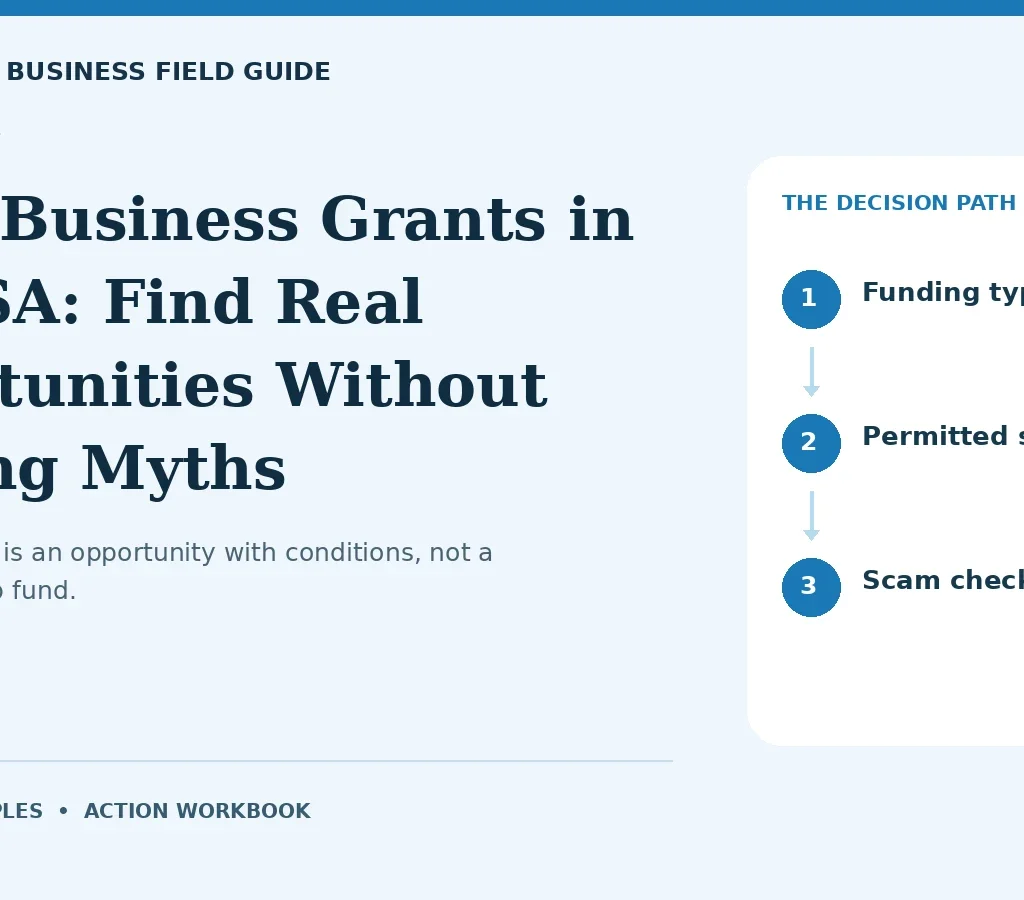
A relevant grant is an opportunity with conditions, not a universal startup fund.
The phrase free money for small businesses attracts attention because starting a company is expensive. It also attracts misleading advertising. A real grant has a defined purpose, an eligible applicant, an application process, and obligations after an award. Your job is to determine whether those conditions match your business before spending days writing an application. This guide provides a screening method for US owners. It does not list invented open programs or imply that every business can obtain public funding. Start with official opportunity documents and treat social posts as leads to verify.
Separate grants from loans and competitions
A grant, a loan, an equity investment, and a private competition are different arrangements. A program described as funding may require repayment, ownership, matching contributions, or reimbursement after eligible spending. Read the actual award terms. The SBA states that it does not provide grants for starting or expanding a business in general; its grant activities target specific purposes. That distinction does not mean no grants exist anywhere. It means the search should begin with a defined objective, such as eligible research, export support, or a location-specific initiative, rather than an expectation of unrestricted cash. Official reference: SBA: Grants, FTC: Scams and your small business.
Create a strict eligibility screen
Check geography, industry, business stage, ownership criteria, project purpose, and any registration requirements. Separate conditions you already meet from conditions requiring confirmation. An attractive award amount is irrelevant if the applicant must operate in another state or perform a different activity. Read definitions carefully. A business with innovative marketing is not automatically a qualifying research project. Contact the administrator through an independently verified official channel when the document is ambiguous. Save the answer with the opportunity record. Never change facts about your business to fit an application.
Check timing and usable cash
A grant may reimburse costs rather than pay before work starts. It may require matching funds or restrict spending to approved categories. Map the cash implications before applying. If you need immediate payroll funding, a long review process or reimbursement arrangement may be unsuitable even when the award is generous. Record opening dates, deadlines, decision timing if stated, and project periods. Do not infer a deadline from an old announcement. An opportunity page should be checked again before submission because a program can close, change, or exhaust its funding.
Write to the scoring criteria
Build the application around the administrator’s published objectives and questions. Explain the problem, proposed activities, measurable outcomes, team capability, budget, and evidence. A general company biography rarely substitutes for a project plan. Use realistic metrics you can report later. If you promise jobs, production capacity, research milestones, or community outcomes, explain the basis. Do not include invented customer letters or unsupported economic impact claims. Clear writing matters, but alignment between the project and the program matters more than dramatic language.
Calculate the application burden
Estimate staff hours, consultant fees, reporting work, and any required match. Compare those costs with the opportunity’s relevance and your ability to complete the funded work. A small company can lose valuable selling time pursuing poorly matched programs. Set a stop rule: if a critical eligibility condition is not met, do not continue simply because you have already started. Maintain a funding calendar, but limit active applications to those you can complete accurately. Reusing a factual company profile is efficient; recycling a mismatched project narrative is not.
Watch for pressure and affiliation claims
An unsolicited message claiming you have already won a government grant deserves independent verification. Avoid sending sensitive documents or paying a processing fee because of an urgent email alone. The FTC provides guidance on scams targeting businesses. A professional-looking portal is not proof of official status. Verify the organization, purpose, and terms. If a paid consultant is involved, understand the service, fee, and cancellation terms without assuming the consultant can guarantee an award. Keep the business viable without the grant; an uncertain award should not become your only cash plan.
A worked example
Illustrative example: a manufacturer finds a $25,000 regional opportunity that reimburses approved training costs and requires a company contribution. The owner first checks location and project eligibility, then models when the training invoices must be paid. The program would not solve this month’s cash shortage because reimbursement follows eligible spending. The company proceeds only if it can fund the project and complete reporting. Meanwhile, a widely shared post promising unrestricted startup cash is rejected because no official administrator or opportunity document can be verified. The amount and program are fictional; the example demonstrates screening rather than announcing an available grant.
Try your own numbers
Change the example inputs to explore this simple planning relationship.
Application effort value ($)Illustrative arithmetic only. This tool does not estimate taxes, loan eligibility, legal requirements, insurance coverage, or net profit. It uses no external service and does not store your inputs.
The worked example and formula above remain available without JavaScript.
Your action workbook
Use the following checkpoints as a working document, not a score that promises success. Each one connects a specific action to evidence and a warning sign. Review the items in sequence or start with the weakest area in your business. The checkboxes are a temporary reading aid; they do not save personal information or certify compliance. Keep any actual records securely in your own operating system. For questions involving legal, tax, lending, insurance, or employment obligations, obtain appropriate current guidance. Your final decision should reflect the evidence, the cost of being wrong, and the capacity to maintain the process after the initial setup.
01 Funding type
Establish the starting point. Identify whether the opportunity is a grant, loan, competition, or investment. Keep this in a dated decision record. Assign any unresolved question to a responsible person before committing money or making a customer promise.
Evidence to keep: The official agreement describing repayment and ownership.
Warning sign: Relying on the word funding without reading the arrangement.
02 Applicant eligibility
Test before committing. Check geography, industry, ownership, and business-stage conditions. Use a representative situation, record the result, and revise weak assumptions before expansion. A small test should inform the next decision, including when to pause.
Evidence to keep: A marked eligibility checklist based on the opportunity document.
Warning sign: Assuming a compelling story overrides mandatory criteria.
03 Project fit
Make the evidence retrievable. Connect the proposed activities to the program’s stated purpose. Store the supporting record with its date and limitations. Compare new findings with the original assumption so changes remain visible to the next reviewer.
Evidence to keep: A project summary mapped to scoring criteria.
Warning sign: Submitting a generic company description instead of a project.
04 Current status
Check the real-world constraint. Verify the opportunity is open and identify the actual deadline. Confirm the practical effect with the responsible operator or qualified adviser. Record whether it changes scope, timing, cost, or the ability to proceed.
Evidence to keep: A dated official page and submission instructions.
Warning sign: Using an old social announcement as a live deadline.
05 Permitted spending
Separate confirmation from expectation. Confirm eligible cost categories and excluded expenses. Label unverified assumptions clearly. Obtain stronger evidence when the decision depends heavily on them, and avoid passing an expectation to others as a guarantee.
Evidence to keep: A budget matching the published definitions.
Warning sign: Expecting unrestricted spending after an award.
06 Cash timing
Assign a usable next action. Determine whether funding is advanced, reimbursed, or milestone-based. Name one responsible person and define completion. Record dependencies on other parties, then follow up through an appropriate verified channel rather than an informal assumption.
Evidence to keep: A project cash calendar including required contributions.
Warning sign: Treating a future reimbursement as money available today.
07 Evidence quality
Compare the alternatives fairly. Collect truthful records supporting capability and outcomes. Use equivalent scope and timing. Record the tradeoff affecting your operation instead of selecting from a favorable headline whose underlying conditions may differ.
Evidence to keep: Verifiable quotes, milestones, and documented experience.
Warning sign: Inventing impact numbers or support letters.
08 Application effort
Plan for the ordinary exception. Budget preparation hours and external service fees. Consider delays, missing records, or weaker results. Decide who notices and what happens next so the process does not depend on an unwritten workaround.
Evidence to keep: A realistic effort estimate with a stop rule.
Warning sign: Continuing a poor match because writing has already begun.
09 Reporting capacity
Turn review into a decision. Assign responsibility for records, milestones, and post-award reports. Choose whether to continue, revise, or pause using the findings. Record the reason and the next review trigger rather than adding activity without resolving the constraint.
Evidence to keep: A reporting schedule and retention process.
Warning sign: Ignoring obligations that begin after the award.
10 Scam check
Maintain the improvement. Verify administrator identity and payment requests independently. Review this after material changes. Keep ownership and current instructions clear, because a completed setup can become outdated as people, conditions, and the business evolve.
Evidence to keep: Official contact confirmation and clear service terms.
Warning sign: Paying immediately because a message says the award will expire.
Make the next decision
Build a grant pipeline that protects your selling time. Keep an opportunity log with the official administrator, purpose, applicant requirements, deadline, eligible costs, cash timing, and reporting burden. Give each candidate a short fit score before drafting. Review rejected opportunities periodically for learning, but do not reopen a poor match merely because the award sounds attractive. Reuse accurate company facts, financial records, and team descriptions across appropriate applications. Rewrite the project explanation for the actual criteria. If an award is received, move the conditions into an operating calendar immediately so compliance does not depend on remembering the original document. If it is declined, continue the business plan that does not depend on the award. A grant can support a defined project, but the search itself should not become a substitute for customers and a viable operating model.
Frequently asked questions
Does the SBA give every startup a grant?
No. The SBA’s grant information distinguishes specific supported purposes from general business startup or expansion funding. Read the official page and the exact opportunity conditions before drawing conclusions.
Should I pay someone to guarantee approval?
A guarantee of an award is a serious reason to investigate the claim. A consultant may provide legitimate application support, but the administrator makes the award decision and the actual contract should explain the service and fee.
Continue with a related guide
Official sources and scope
Sources checked October 12, 2026. Official links support the regulatory and program checkpoints; the business examples, planning methods, and workbook are original editorial material. Rules, terms, and opportunities can change. This is general educational content; use current professional guidance for decisions specific to your business.