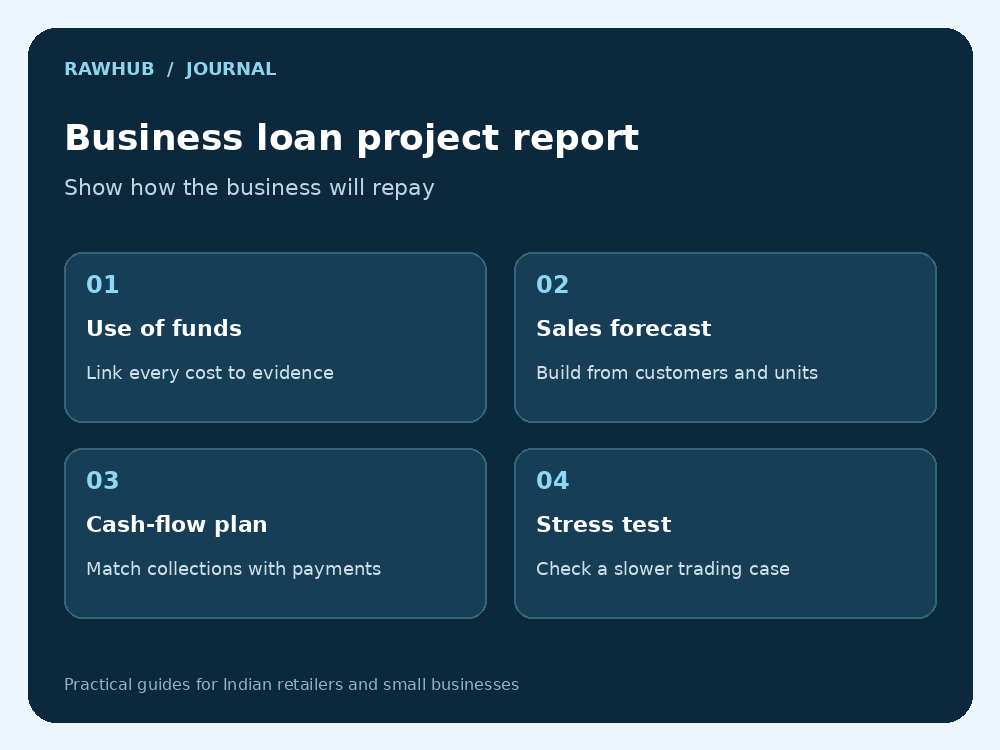
A business loan project report should explain where the money will go and how the business expects to repay it. It is a working document that connects your commercial plan with your financial records. A polished cover cannot compensate for missing quotations, unexplained sales forecasts or a cash shortage hidden behind optimistic profit figures.
For a small retailer, wholesaler or manufacturing unit, the best starting point is a simple operating question: what will change after the proposed investment? Perhaps a refrigerator adds a new product category, a machine improves capacity, or additional stock supports confirmed demand. Describe that change in ordinary language before building the spreadsheet. This guide provides a practical report structure and explains what each section needs to prove.
- Business and promoter background
- Investment purpose and supporting quotations
- Customer demand and operating assumptions
- Project cost and funding sources
- Monthly cash flow and repayment capacity
- Risks, evidence and implementation milestones
1. Write a useful executive summary
Begin with the legal applicant, location, actual activity and purpose of borrowing. State the total project cost, proposed owner contribution and requested facility. Explain whether the proposal concerns a new enterprise, an existing operation or an expansion. The summary should let a reader understand the business without searching through twenty attachments.
Keep this section factual. If you have operated for three years, say which records support that history. If you are starting, describe relevant experience without presenting previous employment revenue as your own business turnover. Separate completed actions from plans: a signed lease, a supplier quotation and an intention to rent a shop are different levels of readiness.
2. Describe the customer problem and sales channel
Identify who will buy, what they need and why they would choose this business. A neighbourhood convenience store serves a different market from a wholesale distributor supplying other retailers. Describe the service area, typical order size, payment practice and purchase frequency. Explain how customers currently solve the same problem and what your offer changes.
Use evidence appropriate to your stage. Existing businesses can show anonymised sales summaries and repeat purchase patterns. New businesses might use genuine enquiries, location observations or small pilot orders. Do not label a casual expression of interest as a confirmed contract. A realistic report distinguishes demand evidence from assumptions that still need testing.
3. Specify the investment precisely
List each major asset or expenditure and connect it to an operational purpose. For equipment, record model, capacity, supplier quotation, installation requirement and expected delivery. For inventory, explain product categories, quantities, purchase price and likely selling period. Include essential supporting costs such as transport, electrical work, basic training or packaging when relevant.
Check what the chosen lender or scheme accepts as eligible project expenditure. Land, used assets, taxes, deposits and working capital can receive different treatment under different programmes. The report should show actual commercial cost even where an item is not eligible for a particular financing route. Hiding an excluded cost creates a funding gap later.
4. Build a transparent sources-and-uses table
Consider an illustrative workshop with ₹8 lakh equipment, ₹1 lakh installation and ₹3 lakh initial working capital. Total uses are ₹12 lakh. If the owner contributes ₹3 lakh and requests ₹9 lakh in finance, sources also total ₹12 lakh. This arithmetic is simple, but it exposes missing money immediately.
| Illustrative use | Amount | Evidence |
|---|---|---|
| Equipment | ₹8 lakh | Current supplier quotation |
| Installation | ₹1 lakh | Itemised estimate |
| Opening working capital | ₹3 lakh | Stock and collection assumptions |
| Total | ₹12 lakh | Matched funding plan |
This is an educational example, not a recommended loan amount. Show where the owner contribution comes from and when it becomes available. Do not count an expected subsidy, an unapproved loan or a refundable customer deposit as unrestricted money already in hand. Explain contingencies and the financing of cost overruns.
5. Make the revenue forecast traceable
Build sales from units and prices rather than choosing a turnover target first. A retailer can forecast transactions per day multiplied by average basket value and trading days. A workshop can start with realistic productive hours, utilisation and saleable output. Account for downtime, rejected units, returns and the time required to acquire customers.
Separate revenue from cash collection. Selling ₹2 lakh on credit this month does not necessarily provide ₹2 lakh for this month’s wages. State the assumed collection period and the proportion of sales made on credit. Keep the original evidence beside the assumption so a reviewer can understand how the forecast was constructed.
6. Explain gross margin and operating costs
Show purchase or production cost separately from selling price. A ₹100 item sold for ₹125 creates ₹25 gross profit before overheads; it does not create a 25 percent margin on sales. Margin on sales in this example is 20 percent. Mixing markup and margin can materially overstate the money available to service debt.
Include rent, staff, utilities, freight, payment charges, repairs, marketing and necessary administration. Explain whether figures include or exclude applicable taxes and remain consistent throughout. Consider owner withdrawals separately from business operating profit because they still affect cash availability. For an existing enterprise, reconcile forecast costs with recent actual experience.
7. Prepare monthly cash flow
Use monthly columns for at least the launch or expansion period, then extend the forecast as the lender requests. Start with opening cash, add expected collections and financing receipts, and subtract operating payments, asset spending, taxes and debt payments. The closing balance should become the following month’s opening balance.
A profitable project can still run out of cash when stock is purchased before sales are collected. Model the actual sequence of payments instead of dividing annual totals equally across twelve months. Our cash conversion cycle guide explains how stock days, customer credit and supplier terms create that timing gap.
8. Show repayment capacity honestly
Insert the proposed repayment schedule using the lender’s quotation or clearly labelled assumptions. Include existing business obligations and any other commitments that affect the applicant’s capacity. A moratorium changes payment timing; it does not necessarily eliminate interest. Ask how accrued amounts are treated before deciding the project can afford the facility.
Compare available cash with scheduled debt service in each relevant period. If a lender requests a debt service coverage ratio, confirm the exact calculation and required format with them. Do not copy a favourable ratio from another report. Different definitions and financing structures can make apparently similar figures unsuitable for direct comparison.
9. Stress-test the weak months
Prepare a downside case with slower sales, delayed collections or higher input costs. Change a small number of assumptions that genuinely matter to your business. For example, test what happens if a major customer pays thirty days late or the first production run sells more slowly than expected. Record the lowest projected cash balance.
Then write a credible response. Options may include reducing the first stock order, delaying optional equipment or contributing additional confirmed funds. “Take another loan” is not a complete contingency unless access and terms are established. The purpose of stress testing is to expose decisions you can change before signing the borrowing agreement.
10. Attach evidence without creating confusion
Build a numbered document index. Typical preparation records include constitution documents, relevant registrations, bank statements, financial accounts, tax records where applicable, quotations and premises information. The final checklist depends on the lender, applicant and facility. Never assume that an online sample report contains every document your application will require.
Use the same legal name and project figures across the report and attachments. Date quotations and explain any material revision. A reviewer should be able to move from a budget line to the supporting document easily. Before sharing, remove unnecessary personal information from illustrative customer material while preserving evidence the lender legitimately needs.
11. Connect the report to the right financing route
A general project report can support discussions, but scheme-specific applications may require their own format and eligibility checks. Read our PMEGP proposal guide if considering that route. Registration, guarantee coverage and subsidy eligibility are separate questions from whether your business plan can generate adequate cash.
For the borrowing agreement itself, use the loan Key Facts Statement checklist to examine cost and repayment terms. Keep the report consistent with the actual offer. If sanctioned finance is lower than requested, revise the investment scope and funding plan instead of proceeding with an unexplained shortfall.
Frequently asked questions
Does a professional report guarantee approval?
No. A lender makes its own assessment. A clear report improves the quality of information available for that assessment but cannot replace eligibility, repayment capacity or satisfactory verification.
Can I use a template?
Yes, as a structure. Replace every assumption with your own evidence. Delete irrelevant sections and retain a calculation trail so the report can be explained and updated.
What should I do before submitting?
Check arithmetic, supporting documents, monthly cash balances and consistency of names. Ask someone unfamiliar with the business to explain the proposal back to you; unclear sections usually become obvious.
References and next step
For official product context, review SBI’s SME lending information and SIDBI’s project funding information. Requirements and availability depend on the current product. Preparation guidance reviewed on 9 October 2026; examples are hypothetical. Start by collecting quotations and a month-by-month operating forecast, then discuss the appropriate facility with the lender.