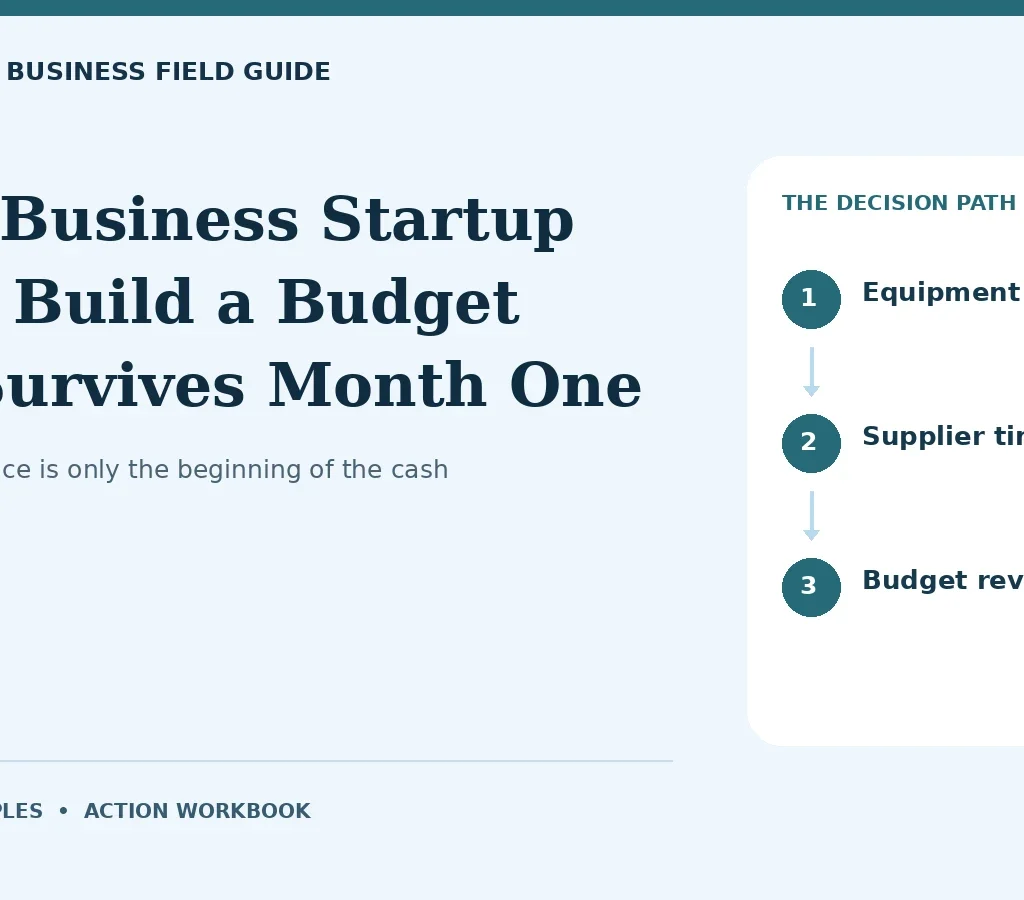
The purchase price is only the beginning of the cash requirement.
Two founders can open the same type of business and need very different amounts of money. One already owns equipment; the other must buy it. One collects deposits; the other waits thirty days for payment. A useful startup budget explains these differences instead of hiding them behind a national average. For a US founder, the goal is not to guess a perfect number. It is to build a transparent model that shows which assumptions matter, when cash leaves, and what remains if sales arrive later than expected. Start with your actual operating design and work outward.
Create three separate spending lists
List one-time setup costs, fixed recurring costs, and costs that vary with sales. A photography studio might buy lighting once, pay software monthly, and incur editing or printing costs per project. Keep refundable deposits separate from expenses because the cash still becomes unavailable even when it is not consumed immediately. Record payment dates and quote validity. Include equipment installation, shipping, training, and maintenance when relevant. A cheap purchase that requires expensive setup may cost more than a higher-priced alternative. Budget using delivered, usable cost rather than the most attractive sticker price.
Model the first operating cycle
Map what happens from the first inquiry to cleared payment. A wholesaler may pay for inventory before customers place orders. A contractor may need materials and labor before a milestone invoice becomes collectible. A consultant may invoice after finishing work. Those patterns produce different working-capital needs even with identical reported revenue. Sketch the sequence before using a spreadsheet. Ask which payments can be aligned with deposits, shorter terms, or smaller initial orders. A budget becomes more accurate when it reflects operational timing rather than dividing annual totals into twelve equal months.
Price the founder’s time honestly
Unpaid founder time makes a budget look lean while transferring the cost to the household. Separate the cash the owner needs to live from the economic cost of performing the work. A launch may temporarily rely on owner effort, but the long-term model should show whether the business can pay for that effort. Estimate hours for sales, fulfillment, customer support, bookkeeping, and management. If all profit disappears when realistic labor is included, reconsider the scope or price before scaling. Low cash spending and a sustainable business are related but different achievements.
Build a downside scenario before a wish list
Write a base case and a slower-sales case. In the slower case, delay revenue without automatically delaying every bill. Rent, subscriptions, and loan payments may still fall due. Ask which expenses can be canceled, which assets can be rented, and which purchases can wait until customer demand is established. Keep contingency visible instead of adding a mysterious percentage to everything. Different risks deserve different buffers. A critical imported component with uncertain lead time deserves a specific response; an optional launch party deserves a decision about whether it is needed at all.
Use contribution to judge the budget
Contribution per sale is selling price minus the costs that increase when that sale happens. It helps you estimate how many sales are needed to cover fixed operating costs. The SBA provides a break-even calculator and explains the relationship between price, variable costs, and fixed costs. Your model should also account for costs that the simple formula omits or treats differently, such as debt principal and startup purchases. Keep break-even analysis alongside the cash calendar. One shows operating economics; the other shows whether money is available on the required date. Official reference: SBA: Break-even point.
Turn every estimate into a verifiable input
Label entries as quoted, contracted, historical, or assumed. Give important assumptions an update date. A contractor’s estimate from last winter may be less useful than a current written quote with exclusions. Check whether taxes, transaction charges, minimum commitments, or deposits are included. Ask suppliers what could change the price. Before requesting funding, be able to explain the largest five line items without reading from a spreadsheet. Clear assumptions make a smaller budget more credible than an inflated total with no supporting evidence.
A worked example
Illustrative example: a local service startup expects $2,400 in setup spending, $1,100 of monthly fixed costs, and $40 of variable cost per $150 appointment. Contribution is $110 per appointment. Ten appointments cover $1,100 of fixed costs before additional items such as owner compensation or taxes. The founder keeps a separate $3,300 operating buffer for three months of fixed costs. That creates a $5,700 initial cash target before any additional working-capital requirements. If customers pay after delivery rather than immediately, the required buffer may increase. The numbers demonstrate the method; they are not local quotes or a promise that ten appointments will be enough for every business.
Try your own numbers
Change the example inputs to explore this simple planning relationship.
Initial cash target ($)Illustrative arithmetic only. This tool does not estimate taxes, loan eligibility, legal requirements, insurance coverage, or net profit. It uses no external service and does not store your inputs.
The worked example and formula above remain available without JavaScript.
Your action workbook
Use the following checkpoints as a working document, not a score that promises success. Each one connects a specific action to evidence and a warning sign. Review the items in sequence or start with the weakest area in your business. The checkboxes are a temporary reading aid; they do not save personal information or certify compliance. Keep any actual records securely in your own operating system. For questions involving legal, tax, lending, insurance, or employment obligations, obtain appropriate current guidance. Your final decision should reflect the evidence, the cost of being wrong, and the capacity to maintain the process after the initial setup.
01 Equipment scope
Establish the starting point. List the equipment necessary to deliver the first paid offer. Keep this in a dated decision record. Assign any unresolved question to a responsible person before committing money or making a customer promise.
Evidence to keep: Delivered quotes including installation and required accessories.
Warning sign: Buying premium equipment before identifying a customer requirement.
02 Monthly commitments
Test before committing. Record rent, subscriptions, insurance, and minimum service charges. Use a representative situation, record the result, and revise weak assumptions before expansion. A small test should inform the next decision, including when to pause.
Evidence to keep: Contracts with payment dates and cancellation terms.
Warning sign: Calling recurring bills one-time launch expenses.
03 Variable costs
Make the evidence retrievable. Calculate supplies, fulfillment, payment fees, and direct delivery labor per sale. Store the supporting record with its date and limitations. Compare new findings with the original assumption so changes remain visible to the next reviewer.
Evidence to keep: A completed order cost sheet.
Warning sign: Ignoring small costs because each one looks insignificant.
04 Owner cash needs
Check the real-world constraint. Keep a separate household budget and decide any planned owner draw. Confirm the practical effect with the responsible operator or qualified adviser. Record whether it changes scope, timing, cost, or the ability to proceed.
Evidence to keep: Essential living costs and a realistic funding source.
Warning sign: Treating personal expenses as if they disappear during launch.
05 Supplier timing
Separate confirmation from expectation. Record deposits, balances, and inventory payment terms. Label unverified assumptions clearly. Obtain stronger evidence when the decision depends heavily on them, and avoid passing an expectation to others as a guarantee.
Evidence to keep: A timeline from purchase order to customer collection.
Warning sign: Budgeting inventory only when the product is sold.
06 Customer timing
Assign a usable next action. Estimate when invoiced revenue becomes usable cash. Name one responsible person and define completion. Record dependencies on other parties, then follow up through an appropriate verified channel rather than an informal assumption.
Evidence to keep: Actual terms and conservative collection assumptions.
Warning sign: Using invoiced sales as the bank balance.
07 Downside case
Compare the alternatives fairly. Delay sales and test which bills remain due. Use equivalent scope and timing. Record the tradeoff affecting your operation instead of selecting from a favorable headline whose underlying conditions may differ.
Evidence to keep: A weekly forecast with revised sales timing.
Warning sign: Assuming expenses automatically fall when sales fall.
08 Contingency reserve
Plan for the ordinary exception. Match each important uncertainty to a specific response and cash allowance. Consider delays, missing records, or weaker results. Decide who notices and what happens next so the process does not depend on an unwritten workaround.
Evidence to keep: A risk list with quoted alternatives.
Warning sign: An unexplained buffer that conceals weak estimates.
09 Purchase gates
Turn review into a decision. Decide which optional expenses depend on confirmed orders. Choose whether to continue, revise, or pause using the findings. Record the reason and the next review trigger rather than adding activity without resolving the constraint.
Evidence to keep: A list of trigger events for later spending.
Warning sign: Calling every desirable purchase essential.
10 Budget review
Maintain the improvement. Replace assumptions with invoices and update the model weekly during launch. Review this after material changes. Keep ownership and current instructions clear, because a completed setup can become outdated as people, conditions, and the business evolve.
Evidence to keep: A variance log explaining the largest changes.
Warning sign: Keeping the original budget unchanged after reality differs.
Make the next decision
A budget becomes a management tool when every important spending decision has a consequence you can explain. If you buy an optional asset now, how many weeks of operating flexibility do you lose? If you rent instead, what changes in monthly commitments and delivery quality? Avoid describing every cheaper option as inferior or every expensive option as an investment. Compare the role each item plays in fulfilling the offer. Keep a short purchase memo for large commitments: purpose, alternatives, total usable cost, cash date, and the evidence supporting the decision. After launch, compare estimates with actual invoices rather than judging the budget only by whether cash remains. A favorable balance can result from delayed bills. A useful review explains why the difference occurred and whether it changes the next decision.
Frequently asked questions
Is a three-month buffer always enough?
No. Buffer size depends on your fixed commitments, payment cycle, seasonality, and ability to reduce spending. Model a downside scenario and choose a buffer that corresponds to the exposure you can tolerate.
Can I use industry averages?
Use them as questions to investigate, not as final answers. Obtain current local quotes and match them to your exact operating scope. An average cannot tell you whether installation, deposits, or labor are included.
Continue with a related guide
Official sources and scope
Sources checked October 12, 2026. Official links support the regulatory and program checkpoints; the business examples, planning methods, and workbook are original editorial material. Rules, terms, and opportunities can change. This is general educational content; use current professional guidance for decisions specific to your business.